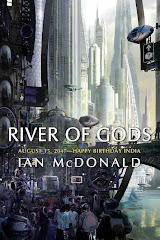
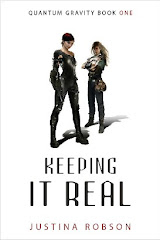
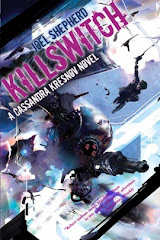
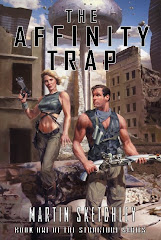
Showing posts with label Chris McGrath. Show all posts

Tuesday, November 2, 2010

The Greyfriar (Vampire Empire Book 1) by Clay & Susan Griffith

“I was blindsided by how phenomenal The Greyfriar was from start to finish. Amazing vampire mythology, a chilling alternate history, and a poignant romance that grips your whole heart and refuses to let go. …The vampires in The Greyfriar are frighteningly fascinating. …As rich and absorbing as the vampire empire is, the heart of The Greyfriar was the blossoming romance that grew between Adele and Greyfriar amidst the war between humans and vampires. It was moving and heartbreaking at every turn. … I’m amazed that a story as epic and lavish The Greyfriar comes in at just over 300 pages. That’s a testament to writing ability of husband and wife duo Clay and Susan Griffith who wasted not one word in their superb vampire steampunk novel. The action is exhilarating, the vampires are refreshingly sinister, and the love story a gentle force so captivating that I truly believe it will weather even the most daunting obstacles. Book two in the Vampire Empire can’t come soon enough. My rating: 5/5, Near Perfect - Buy two copies: one for you and one for a friend.” -All Things Urban Fantasy blog, October 26, 2010

“The best book I've read this year...I'm hoping to convince you all to buy this book...a page turner...all-around satisfying, pick this one up. Romance fans will not be disappointed...” -VampChix blog, October 21, 2010

Read an excerpt from this highly anticipated book here:


The Greyfriar (Vampire Empire Book 1)
Clay & Susan Griffith


CHAPTER 1

“YOUR HIGHNESS WOULD be safer below. It’s getting dark. Vampires are very unpredictable.”

“Thank you, Colonel. I believe I’ll stay on deck a bit yet. It’s quite warm. That should keep the beasties quiet. Yes?”

Princess Adele noticed a slight smile on the dark, chiseled face of Colonel Mehmet Anhalt, who stood close to her, as was his habit. Under her gaze, the short but powerfully built Gurkha officer covered his bemusement by clearing his throat and offering his brass telescope. “In that case, Your Highness, would you care to have a look?”

“Yes, I should. Thank you, Colonel Anhalt.” Adele crossed the quarterdeck of HMS Ptolemy and leapt with girlish pleasure down three steps to the ship’s waist. A crowd of redjackets from her household guard parted to make a path to the port rail. A stiff breeze rolled the heavy skirt around her calves and whipped the ends of the scarf that struggled to restrain her long auburn curls.

Adele snapped open the telescope and steadied her booted feet expertly against the airship’s sway. The distant clouds were turning brilliant orange and bruise purple in the darkening eastern sky. Five miles
off the port beam Adele spotted two figures floating silhouetted in midair.

Vampires.

The young princess felt a delicious thrill spread through her. Vampire cadavers were displayed occasionally in the streets of her home, Alexandria, and she had even viewed the purported preserved head of the clan chief of Vienna, but she had seen only a few living specimens in her days. These two lay spread-eagle on the air, vibrating in the drafts that buffeted their nearly weightless frames.

Adele felt a tingle of horror when one turned its head and, she thought, stared at her, looking in her eye with its cold glare. She closed the glass with a sharp breath, going pale. Frustration swept through her that the creature should startle her so. It was not as if the beast had truly been looking at her. It merely had looked toward the ship. Struggling to regain her composure in front of her guardsmen, she resumed strolling the quarterdeck.

A young boy suddenly exploded up out of the main hatch. His face was red from the exertion of racing up the companionways, as indeed he raced everywhere he went. He was barely twelve years old and still round-faced as a baby, with darker hair than Adele’s, cropped short. A flowing striped cotton Bedouin robe over breeches and sandals made him look like a ragamuffin from the alleys of Cairo.

He scampered to Adele’s side, shouting, “I heard there are two of them out there!”

Princess Adele cut a very different figure from her wild younger brother, Simon. She was the heir, the future empress, and her very proper traveling garb was chosen for reasons of state. Today she wore a heavy cotton shirt, a leather jacket with a Persian sash, and a long velveteen skirt covering high leather boots. In the sash, she had her prized weapon, a jewel-hilted khukri, a broad-bladed dagger that had been a gift from her mother. More, it was a Fahrenheit blade, with chemical additives in the scabbard that gave the steel an intense chemical heat when exposed to air, making it more destructive than a normal blade.

The blade was not all Adele had received from her Persian mother. A light veil wrapped her head and shoulders to protect her against the sun and wind. Unlike her brother’s red-cheeked visage that he got from their father, Emperor Constantine II, Adele had olive skin and the distinctive nose of the late empress. Her appearance was a subject of murmured derision among the northern-featured courtiers who dominated the imperial court in Alexandria.

“They’re very far away, Simon.” Adele put an arm around her brother’s shoulders. While two lone vampires posed little threat to a heavily armed Ptolemy, she still would have preferred her brother locked safely below.

Prince Simon looked disappointed. “Can I look at the vampires, Colonel Anhalt?”

May I look at the vampires,” Princess Adele corrected with a light cuff to the boy’s shoulder.

Anhalt was perspiring in his tightly buttoned uniform. “Unfortunately it’s grown too dark for observation, Prince Simon. And Khartoum has blocked our view.” He bowed stiffly to the eager prince, indicating a thirty-two-gun frigate maneuvering through the gathering clouds four miles off the port quarter. HMS Cape Town, Mandalay, and Giza were putting on or taking off sail, struggling to answer the signals to form the nightly cordon around the flagship.

“And you’ve seen vampires before,” Adele argued to Simon.

“So?” The boy craned his neck, straining to peer into the east through the billowing sails of Khartoum. “It’s probably the most interesting thing that will happen on this trip.”

Adele noticed a stony glare on Colonel Anhalt’s face as he looked in the direction of the vampires. It was unusually harsh and uncharacteristic of the man.

“Something, Colonel?” she asked, handing the spyglass back to him.

The Gurkha blinked in surprise, then flushed with embarrassment. He studied his polished boots. “No, Highness. Nothing.”

“Your expression said otherwise.” She stepped closer to him. “Feel free. Have I done something wrong?”

The colonel looked up suddenly, mouth agape. “No! I would never—never—”

“Easy, Colonel.” Adele smiled warmly and laid a hand on his forearm. “You merely looked angry. Is there something wrong?”

He wrestled with his thoughts for a moment, and then said, “Forgive my bluntness, Your Highness, but I think it unwise to send you so far north on tour.”

Adele nodded in consideration.

Anhalt continued. “And to send both heirs. I don’t know what the court was thinking. It’s irrational.”

“Politics aren’t always a matter of the most rational path. I am happy to be here, forging goodwill.” Adele, in fact, was thrilled to be away from Alexandria, on board this tossing ship. The alternative was to be at home, immersed in court tedium. When Lord Kelvin, the prime minister, had suggested the tour, Adele had leapt at the opportunity. But she couldn’t just make the argument that she enjoyed the adventure. There was a purpose, and it was one that was important to her aside from escape. “It’s imperative that the independent city-states on the frontier, such as Marseille, see the future empress of Equatoria. The connections I can make on this tour could be very helpful. There is a war coming.”

This was a fact both Adele and Colonel Anhalt knew well.Within a year, conflict would begin that would reshape the world in blood. Adele was no warmonger, but she knew the fight was necessary.

It had been 150 years since the vampires rose. The monsters had lurked quietly among humanity from the beginning of time, but one dark winter night in 1870 they came en masse intent on subjugating human society. It was not known why they chose that moment to attack.  Perhaps a great leader had inspired them. Perhaps they sensed a particular weakness in human culture as it teetered between faith and science. And clearly, humans were not prepared; they were taken totally by surprise. Most people had even given up their beliefs in the existence of such creatures as vampires.

The vampires struck at the hearts of the Great Powers of Europe, America, and Asia. They decapitated governments and armies, and destroyed communication and transportation. Order was replaced by
horror, panic, and collapse. Within two years, the great industrial societies of the north were cadavers and the vampire clans divided the old world between themselves.

At that time, no one had understood the true nature of the vampires. Few enough did, even today. Adele, however, had the benefit of the dons of the Imperial Academy of Sciences in Alexandria to teach her what was known, or thought was known, of the biology and culture of humanity’s greatest enemy. Myths about these creatures had grown up over the centuries—myths that were based on truths, but not the truth. Vampires were far more dangerous than the old legends could have imagined.

Most respected men of science stated with certainty that vampires were not the resurrected corpses of humans. The creatures were now classed as a parasitic species that thrived on human blood, and they had been categorized Homo nosferatii. Vampires and humans had disturbingly similar anatomies and physiologies, except that vampires had sharper teeth, retractable clawlike fingernails, and eyes acutely adapted to nocturnal hunting. Four of their five senses were magnificent; sight, smell, hearing, and taste were well beyond the level of a dog or cat. However, vampires had a stunted sense of touch, making it difficult for them to manipulate objects or use simple tools. Anatomy lessons conducted in the gaslit chambers beneath the Imperial Academy of Sciences in Alexandria had demonstrated that vampires seemed to feel no pain and rapidly healed from even the most horrific wounds.

It had never been demonstrated convincingly that vampires created new vampires by infecting humans. Scholars debated with great vigor how, or even if, vampires propagated. There were many theories, but the current dominant belief among the learned was that the creatures lived forever and that there were as many now as there had ever been or would ever be.

Vampires had never been seen to transform into bats or wolves, but they could travel on the wind by amazing control over their density, which was not yet fully understood. Specimens rarely lived long enough in captivity for satisfying experimentation. Sunlight did not turn them to dust, but they were pathologically susceptible to heat, which made them weak and lethargic. Hence, their tendency to come out at night and haunt northern climes.

Certainly none of this latest scientific knowledge had been available to the terrified victims of the Great Killing in 1870. After those attacks, hundreds of thousands of humans had fled south toward the equator, where they sought refuge in colonial possessions and fought savagely for land in a great frenzy of cultural collapse and coalition. Eventually the shell-shocked remnants of northern humanity blended with local people and set about trying to re-create new versions of their beloved societies based on steam and iron in the wilting tropical heat where vampires rarely trod.

Prince Simon scrambled to the rail again. “I think I see them!” He looked back at Colonel Anhalt with a pleading gaze.

The Gurkha offered the young prince his spyglass before turning his attention back to the princess, his hand resting on the hilt of his Fahrenheit saber, an officer’s weapon. “I still think it’s foolish to waste your time currying favor with the border states. There are only two sides to this war: human and vampire. What’s the purpose of diplomacy with those who will need us once the fighting starts?”

Adele sighed cheerfully. “You’re just argumentative. You know it isn’t that simple. We will need the independent states on the frontier as much as they need us. We will want their ports and facilities to move our armies into Europe. Isn’t it better to have an understanding beforehand?

No one expects a human state to side with the vampires, but the border states have self-interests too. And there will be opportunities for the Empire to expand as we roll back the vampires. Our world is about to change forever.”

Adele’s world was very different from the one her great-grandfather would’ve known, and which she had read about in history books. There were new Great Powers that were like the resurrected corpses of the world powers at the time of the Great Killing. Her own Equatorian Empire was built on the ruins of the British Empire. It stretched from India to South Africa, with its great capital set amid the dusty mosques of Alexandria. The American Republic was a republic in name only. It was ruled by an oligarchy of wealthy families from its center in the torrid quietude of Panama with firm control over most of Central America and theWest Indies, and growing hegemony over the southern region of the old United States.When the vampires attacked Japan, that emperor removed himself to Singapore and spread his power over the green temples of Malaya and much of Southeast Asia. The world over, a
dizzying array of semi-independent city-states struggled along the vampire frontiers, where warm summers made it difficult for the monsters to extend their power on a permanent basis.

Those who traced their heritage to the north remained galled by the vampire clans’ continuing domination of the old lands. They always talked of returning “home” and driving the vampires back into the darkness.

Now that moment was at hand.

The human states believed they were sufficiently reorganized to strike and had the proper technology to counter the swift, savage hordes of the vampire clans. A brutalWar of Reconquest would begin with the coming of spring in the north.

And Princess Adele, standing windswept on the deck of Ptolemy, was a linchpin in the strategy. It was her birthright to be part of the bloody struggle for the future of the world. She was the matrimonial prize that would unite the two greatest human states into an allied war machine.

Adele regarded the imposing figure of Colonel Anhalt and laughed at his worried scowl. “Thank you for your concern, but surely nothing will happen. We are far south of clan territory. Marseilles hasn’t been attacked in—what—fifteen years?”

“Seven, Highness.”

“Seven then. And the weather is quite warm. As our meteorologists predicted.”

Anhalt grunted in tepid acceptance of her logic.

“And I have my White Guard around me.” Adele smiled at the furrowed brow on the dark face before her. “You’ll keep me safe, won’t you, Colonel Anhalt?”

There was a sudden and surprising glisten of moisture in Anhalt’s hard eyes. “With my life, Your Highness.”

Adele replied, “Dear Anhalt. Where would I be without you?”

“I pray you never have to find out.”

“I as well.”

A nervous young naval officer stopped and bowed. “The admiral’s compliments, Your Highness. He says we will have chemical lights momentarily, and perhaps you should consider moving belowdecks.”

The princess replied with proper formality, “Thank you, Lieutenant Sayid.” And she noticed his surprise and pride that the imperial heir recalled his name. “I think that two vampires would hardly dare attack an imperial capital ship of one hundred guns.”

“One hundred and fifteen guns, Your Highness,” the boy responded stiffly.

“Indeed?” Adele smiled. “Impressive. But in any case, since vampiric vision is reputed to exceed a cat’s, surely they could easily perceive the better part of a regiment on deck.”

Lieutenant Sayid raised a knuckle to his brow in salute and immediately turned to pass orders to the bosun’s mates with a less nervous voice. Then he pulled appropriate signal flags and stuffed them into
hardened gutta-percha cylinders. The foot-long cylinders went into shining copper pneumatic tubes and were shot to the platforms high in the ship’s rigging.

Princess Adele watched as gangs of sailors clambered up the shrouds and ratlines toward the gigantic, gas-filled dirigible overhead. The dirigible was encased in a tightly crosshatched metal eggshell designed to protect it from enemy cannon fire. A row of three wooden masts extended laterally from each side and also along the top spine of the steel frame. Sails were set in concert with filling and evacuating parts of the multichambered dirigible, to propel and steer the massive airship. It was an intricate ballet, a wonder to watch.

Simon glanced at his big sister. “You want to be up there with them, don’t you?”

A startled Adele began, “Don’t be silly. . . .” Then she stopped and responded honestly, “Yes. And so do you.”

The boy laughed and nodded his head vigorously, craning his neck to get a glimpse of the fearless sailors. Adele dropped her arm around her brother’s shoulders and followed his gaze upward, feeling a powerful desire to climb the quivering lines alongside the sailors and scale the dizzying main topmast swaying high above the airship to feel the clouds on her face. She envied those simple men who shouted, laughed, and even sang in the wind-ripped tops with only the sureness of their grip separating them from a long but certain death.

On the blustery quarterdeck, Lieutenant Sayid interrupted her thoughts by touching the brim of his cap politely. “Your Highness, if you would please step to this spot between the carronades. I would be loath for you or the prince to be struck by an inconsiderate falling airman.”

Simon immediately planted himself and stared up at the swelling sails, forcing Adele to tow his rigid form against the rail. She began to say something to the young officer, but he was already engaged in another duty. With a heavy sigh, she leaned against the hardmahogany gunwale, content to monitor her restless brother in the gathering darkness.

A maid appeared from below with Adele’s heavy cape and a coat for Simon. The weather was too warm for a cloak, and Adele would have refused, but the maid was only following orders. If the poor girl returned below with the cloak still in her possession it would create a crisis that would envelop Adele’s entire staff. The maid confidently informed Adele that dinner was in exactly twenty minutes. Then, on her way below, the servant exchanged light, bubbling words with the handsome Lieutenant Sayid. Adele watched them, fascinated by the mix of hesitance and boldness; a young woman, a handsome officer. Such charming simplicity.

A sudden flash of moonlight reflected in the ostentatious diamond ring on Adele’s left hand and forced her to remember her wedding was barely a month away. It wasn’t so much a wedding as the starting gun for the war, the signal that Equatoria and the American Republic were one. All the linen, china, and warships would be bound to the same household. Adele thought of the beautiful gold locket that held a picture of her Intended, Senator Clark. War hero. Vampire killer. Scion of a great American house. Undeniably handsome. He had the open brashness of an American, which in another situation she might have found attractive.

Still, the young woman had generally refused to think about the Impending Event because the thought of a stranger’s weight on the other side of her bed caused many sleepless nights bathed in a frightened
sweat and with a shortness of breath. She couldn’t conceive of how her Intended’s war-roughened hands would feel on her skin, nor did she want to. Her spy inside the Office of Court Protocol had confided to her that the issue of sexual commerce was still under negotiation and, although it probably could not be eliminated completely, it would at least be kept to the minimum necessary to conceive an heir. The marriage was a political necessity and, therefore, Adele’s duty, but she doubted it would ever be more than that.

Adele reached up absently and through her heavy blouse damp with perspiration she felt the small stone talisman hanging around her neck. She wore it instead of the beautiful gold locket with a photo of her Intended, which was buried deep in her luggage. Her revered mentor, Mamoru, had given her the religious stone talisman for protection, and it gave her a sense of solemnity and calm. But Adele kept it hidden; no one could know that their princess wore such a superstitious item. Members of court already suspected that her youthful exuberance was a dreadful portent of her failure as empress. Surely they didn’t need to know that she had a penchant for the occult and miraculous. The better” class of people in Equatoria put religion and magic in the same category. Churches and mosques and temples still existed, and services were still held, but those who attended were viewed as quaint at best and deranged at worst. Mamoru was a very spiritual man, and Adele found that part of him fascinating. He claimed that spirituality and naturalism, as much as steel and steam, would destroy the vampires. It was
only a matter of firm belief and correct practice.

Ptolemy began to glow with the quavering blurs of chemical bulbs. The other ships in the fleet appeared as vague yellow smudges in the night sky. Far beneath the ship the earth was hidden in a swallowing blackness that had fascinated and terrified Adele since they had left the civilizing lights of the Empire for the vampire frontier of southern France.

Prince Simon’s urgent voice interrupted Adele’s thoughts. “Do you think we’ll meet the Greyfriar out here?”

Adele shook her head with confusion. “What? The Greyfriar? What in the world are you talking about now?”

“The Greyfriar! He’s a hero who fights the vampires in the north.”

“Oh, yes. No, of course not. He’s not even real, Simon. Just a story to make people feel better.”

Simon narrowed his eyes at his sister’s ignorance. “He’s not a story. He’s real. I saw pictures in a book. He carries swords and guns and wears a mask. People say he killed a hundred vampires in Brussels. A hundred!” The young prince began to wave his arm around as if he had a sword, striking and slashing. “He’s a master fencer with all blades! His swords move so fast vampires can’t see them! Whoosh whoosh whoosh! Their heads are rolling before they even know the Greyfriar is there! Hah! Colonel Anhalt, you believe in the Greyfriar, don’t you?”

The soldier said over his shoulder with mock solemnity, “Indeed I do, Your Highness. I heard he killed a hundred vampires in Brussels too.”

“You see, Adele! I told you!”

Adele replied, “Simon, be still.”

“Why can’t we meet him? I’ll bet if we told him we were coming, he’d meet us. We’re the royal family of Equatoria.”

“We can’t see him because he’s not real! Now stand still and mind me!”

Simon huffed. “Well, then, will they let me command the ship?”

No, of course not,” Adele snapped irritably. Then she blinked and said more softly, “Not now. Perhaps tomorrow when it’s light.”

Adele wanted to nurture Simon’s youthful curiosity and excitement, not stifle it. His enthusiasm was important. The Empire needed men like Simon, brazen and curious. Currently at court, to her dismay, there already were far too many of the venal type of man he would become if the palace drudges got their talons on him.

“Why not?” Simon wandered from her side, intent on exploring the ship’s wheel, where blazingly bright copper pneumatic tubes gathered to form something like a Baroque organ. Prince Simon was due to become an officer in the Imperial Navy, and this idea excited him.

Colonel Anhalt coughed commandingly at the young prince as small hands played over the pneumo tubes.

Adele darted from the rail and grabbed her brother’s arm. “Simon, don’t get in the way!”

“I’m not going to hurt anything!” the boy retorted.

They were interrupted by the clack of a pneumo arriving from the tops.

With his back straight, Colonel Anhalt said to Simon, “Would Your Highness care to retrieve that signal from the chief of the top mizzenmast?”
With a yelp of joy, Simon lifted a round copper flap, and a rubber cylinder dropped out into his hand along with a splash of dark liquid. “Ew. What’s this?” He lifted his stained fingers into the yellow light.

Oil or grease, Adele thought with mild exasperation, automatically reaching into her pocket for a handkerchief. Anhalt stared at Simon’s hand with furrowed brows. He pulled the pneumo cylinder from the boy’s grasp and sniffed it.

“Blood,” the rough soldier murmured. Abruptly his stern visage turned on a horrified Princess Adele. His voice was firm and demanding. “Your Highness, take your brother below, if you please.”

Adele put one hand instinctively on the hilt of her dagger and with the other tugged Simon toward the main hatch as Colonel Anhalt gazed up at the vast dirigible one hundred feet over his head as if trying to see through it to the invisible topmasts above. Several naval officers on the quarterdeck stopped chatting among themselves and watched with growing interest.

Suddenly the airship lurched. Adele grabbed a pneumatic tube for support and pulled her brother back to his feet. In the rigging high above, she saw a figure tumble sickeningly, flipping this way and that,
unable to grasp a safe hold, until he shot past the deck into the black atmosphere below the ship. Before Adele could understand that sudden tragedy, another man fell and then another. Then she saw strange shadowy things moving with unnatural agility down through the lines, pulling hand over hand toward the deck.

Two dark cadaverous figures settled to the deck amidships with no sound and lifted their bloodstained faces into the light. Adele saw true savagery for the first time. These vampires were not stories or frightening figures in the distance; they were real, covered in blood that glistened in the lamplight. She clutched her brother close.

Sailors stared at the horrific intruders. A squad of redjackets raised their rifles and opened an erratic fire. One vampire was blown off his feet. The other streaked forward, a blur in the half-light, and two soldiers screamed. The wounded vampire then bounded to his feet and also rushed into the fight. It was a short, bloody affair.

Two other vampires dropped onto the quarterdeck, hissing like cats, only yards from Adele and Simon. One leapt at Simon, too fast for Adele to scream or react.

The vampire’s head exploded and the body tumbled.

Anhalt appeared at Adele’s side with a smoking revolver extended and Fahrenheit saber in hand. “Get below! Quickly!” He fired twice, hitting the second vampire in the head, and it dropped palsied to the deck.

“Form square!” Anhalt bellowed over the staccato gunfire erupting across the deck. “Fix bayonets! Up and out! Up and out!” Soldiers scrambled for the quarterdeck and gathered into a ragged square around the main hatch. The men fumbled with bayonets and tried to work their rifles as they’d been drilled, each trooper alternating his aim out or up to cover both ground and air. Some young faces were blank, others stained with horror and blood.

Adele sent her brother down into the companionway. She saw the rigging over her head was full of vampires, perhaps a hundred of them squirming and crawling, like a dead tree full of caterpillars. Then the two royals were below, where soldiers and sailors raced frantically through the corridors. Officers shouted orders and counterorders that were lost in the din of tramping feet. Anhalt dropped quickly through the hatchway and detailed five soldiers to accompany Adele and Simon into the bowels of the ship.

They went down and down, past the acrid-smelling chemical room, into the reeking orlop deck. They were taken to a small dark chamber, fore or aft Adele could no longer say, inhabited by goats, pigs, and crates of chickens.

“You’ll be safe here, Your Highness.” A soldier shoved the royal siblings into the manger, then slammed the door shut.

For a long time, neither Adele nor Simon spoke in the blackness. She hugged her brother, noticing that he was shivering, his unblinking eyes staring at a small goat that stood in the straw nearby. They strained to hear traces of the battle, hoping for hints of victory. Surely, the finest troops of the Equatorian Empire could defeat vampire raiders. The vampires would flee like vermin once they realized that this was not a lazy merchant vessel that had strayed too far north.

The room shuddered and made a heart-sickening lurch to starboard. Simon screeched and squeezed Adele as they tumbled across the manger. Trying to cushion Simon’s body, she hit the bulkhead amid a pile of chicken crates. Adele lifted a crate off her brother and brought him closer.

After several frightening minutes in the dark, the door flew open and Colonel Anhalt appeared with a horrid gash marring his dark face, his tunic torn and drenched in blood. He carried a trooper’s carbine and his saber, smoking with boiling blood. “Highness, quickly if you please. The ship is going down.”

Adele climbed to her feet. “Lifeboats?”

“No.” Anhalt shepherded the royal pair from the room. “Too unsafe.” Airship lifeboats were small gondolas attached to chemically inflated balloons; easy prey to vampires. Three soldiers moved ahead and four fell in behind. As the group climbed to the gun deck the chemical lighting went out, plunging the ship into pitch black. The hallway was listing at a rough angle, and footing was treacherous. Ahead, sailors were filling a room with mattresses and rolled hammocks. Anhalt indicated for Adele and Simon to go inside. “Stay here, Your Highness. And don’t worry.”

Adele pushed Simon to the floor, where he stayed compliantly. Sliding her hand off her brother’s stiff shoulder, she moved back to her trusted Gurkha colonel and whispered, “What’s our situation?”

Anhalt hesitated, but after staring into the steady eyes of the young woman he admired, and again realizing why he admired her, he said, “The vampires have destroyed most of the sails and damaged the dirigible. And we can no longer stay aloft. The White Guard is losing the deck.”

“How is this possible?” she asked, incredulous. “Raiders don’t—”

“These aren’t raiders, Your Highness. This is a full-scale attack by clan packs. They mean to destroy this ship. Perhaps the entire convoy.”

“That’s incredible! Surely we have the firepower to stop them.”

“I hope so. Vampires are desperately hard to kill. The monsters do not know they are injured until they are in pieces. Even with a Fahrenheit blade, you have to destroy a vital organ or sever the head.”

“How many are there?”
He shook his head and hefted his red saber without outward emotion. “Fewer now.”

“How many men have we lost?”

“Many,” Anhalt answered, and turned to leave.

Adele noticed the bloody footprints left by the colonel and his four White Guardsmen, and anger raced through her. The door closed and she knelt beside Simon, dragging a mattress over them. She sang softly to her brother, a lullaby she used to sing to him when he was a baby. They waited.

Adele heard a strange sound mixed with her own voice.

But there was so much noise enveloping the ship that at first Adele dismissed the sound as just part of the battle. Then it came again from just by her ear. It was coming from the other side of the bulkhead. She strained to hear. Men running? The creaking of stressed timber? Rats scurrying for safety? There was something about it that didn’t seem to fit any of those.

“What is that noise?” asked Simon in a small voice.

“Nothing,” Adele responded. “It’s nothing.” But the anxiety inside her wouldn’t go away. She shifted and eased Simon away from the wall. From within her cape emerged her Fahrenheit khukri dagger. The glow from the blade gave her some small comfort, but couldn’t stop the wild pounding of her heart.

Then the wall started to break apart.


CHAPTER 2

ADELE AND SIMON were showered with splinters as a hole was punched in the wall and a thin object snaked through. Something sharp dug into the young woman’s side. There was a horrible hissing noise, almost one of pain as it grabbed her. Arching back with a cry, Adele instinctively slashed at what held her. Her blade came into contact with something long and bony. An arm!

Simon was shouting. The pale arm of another vampire had reached through another hole and was dragging him toward the bulkhead.

“No!” Adele grabbed Simon and stabbed the arm holding him. There was no satisfying screech of pain from behind the wall, only the smoldering stench of burning flesh from the khukri’s chemical, which
would continue to burn for some time.

A skeletal hand slapped the dagger from Adele’s trembling fingers, sending it skittering across the floor. Simon was yanked away from her, and he crashed against the splintering bulkhead. Claws tore at the wood, widening the hole behind Simon.

Adele staggered to her feet and tore through debris for another weapon. Without one, she and Simon would be lost. Her hand landed on something metal, slender, and over two feet long; it was a marlin-
spike. She spun it around and jabbed the closest vampire arm. The small grunt that echoed gave her hope that she could hurt them.

“Adele!” Simon shouted in a panic as he struggled to keep himself from being pulled through the ever-widening hole. The vampire on the other side didn’t seem to care that he didn’t quite fit. It was desperate to have him.

Adele struck again at the hand gripping Simon’s shoulder. “Hold on, Simon!” There was less than an inch of space between her brother and her target, but the steel tooth hit its mark and plunged through the thin wrist. The claw released Simon, and the boy scrambled around his sister.

Adele held onto the spike like she had gaffed a thrashing fish. The hand twisted unnaturally and grasped the tool, ripping itself free of the spike and tearing its own wrist to shreds before pulling its arm back through the wall to safety.

Glancing wildly about for the direction of the next attack, the royal siblings backed away, though there was little space for them to go.

Then a wide portion of the weakened bulkhead close to the deck shattered in a cloud of dust and wood splinters. Through the haze of smoke and dust Adele was looking at the female vampire face that she had seen through the spyglass while on deck earlier. Now there was nothing to stop the vampire from coming in.

Adele dragged Simon with her as she retreated. He was softly crying against her. She could feel her brother’s fear mixing with her own. But there was no time for comforting words, because the face of death appeared in the hole, head and shoulders visible as a long bony arm clawed for purchase.

Determined to protect her brother, Adele reared back with the spike and stabbed again. The spike sank through ribs and flesh and embedded deep into the wood, pinning the female to the deck. The creature bared her teeth and hissed, thrashing in anger, but she couldn’t free herself.

The ship shuddered and threw Adele and Simon to the deck. Their stomachs lurched as the big vessel dropped sharply. Everything in the cabin started a slow slide. Adele grabbed a mattress and tried to use it to shield them.

“We’re going down!”

~~~

HMS Ptolemy hit the ground.

The impact tore Adele and Simon from under the mattress, throwing them into the air and slamming them against bulkheads. Adele tumbled for what seemed hours. Her world was noise and pain. She no longer knew up or down.

When everything finally stopped, Adele lay still in the flickering dark and choked, “Simon! Simon! Are you all right?” There was no answer. She heard nothing—no screaming, shooting, or explosions.
Clawing at the mattresses and rolled hammocks around her, she struggled to stand but was unsure how or where to put her feet. She could smell smoke; the ship was on fire. They had to get out.

Adele saw a small leg sticking up awkwardly into the air. The frantic girl scrambled to it and grabbed the ankle. Tearing at the wreckage, she reached down, feeling along her brother’s torso, and gathered
the front of his robe. With all her strength, she pulled Simon up out of the maw. She stared at his face; his eyes were open.

“Are we dead?” he asked her, coughing against the smoke and dust.

Adele pressed her face against his heaving chest. “No. We’re fine. We made it. Now we just wait for another ship to come and pick us up.” It was a pale attempt to reassure him, and her eyes darted around them. But no frightening faces stared back at her.

Together, the imperial siblings took unsteady bouncing steps across the jumbled mattresses to the door of the cabin. A glint of light caught Adele’s eye, and she saw her dagger lying amidst the debris, the chemically heated blade now cooled into a normal weapon. She snatched it up with a small yelp of triumph and slipped it back into the scabbard at her belt to be charged once more. Adele’s shoulder and legs felt hot, but she didn’t pause to look for injuries. Better not to know for now. They kicked wreckage away from the door, which she then wrenched open. The corridor outside was a world of debris. Wooden planks and metal rods, barrels, and broken beams created a jagged landscape. Redjackets who had been standing guard outside the door were trapped in the chaos. All were dead. Adele shielded Simon’s eyes.

As quickly as they could, the two made their way from the remnants of the cabins into the open gun deck. Massive iron cannons on their huge wooden carriages, each weighing several tons, had broken loose and were scattered like toys or carelessly thrown pieces of driftwood. Sailors stumbled through the wreckage, some helping comrades who were trapped or injured. The hot dusty air was filled with muted moans of pain and anguish, and the smell of smoke and blood.

Adele saw the night sky above through a long fissure in the ship’s bulkhead. “Up there,” she told Simon. “Let’s climb.” She helped the boy clamber his way up the tilted deck. They grabbed whatever handholds they could find. Wreckage shifted suddenly, threatening to throw them down, but they finally reached the jagged hole and emerged onto the sloping hull of the overturned hulk.

Taking in great breaths of fresh air, Adele turned to her silent brother. “Are you hurt?” She touched his limbs and head. She wanted him to talk. She wanted him to react.

The young prince flexed his elbows and knees, then shook his head. “No. Everything works.”

“Me too.” Adele laughed and kissed the top of her brother’s head. “We’ll be okay.”

The gem of the imperial fleet had smashed through a Provençal forest, leaving behind a wasteland of uprooted trees. The airship was heeled over on her starboard side with the dirigible and its metal shell
shredded. Masts were snapped and scattered across the great mounds of earth the crashed ship had gouged up. Men crawled out of gashes across the length of the hull and wandered over the vast beached wooden whale. Adele helped several of them while speaking calmly and encouraging them as best she could. It was her duty in a crisis. Men also moved around on the ground. She saw surviving White Guardsmen among them and searched unsuccessfully for Colonel Anhalt and members of her household staff. She prayed that Colonel Anhalt was still alive.

Adele turned her gaze up to the cloud-filled sky, searching for the glows of the other ships in the fleet. She thought she saw a faint yellow blur, but couldn’t be sure. Then she noticed tiny, wavering shapes flitting over the face of the grey clouds.

How was this possible? It was even warmer on the ground. Why were they still coming? What was driving them?

Adele tried to push Simon back inside the ship’s hull as a vampire landed near her. The creature seized Adele’s arm, but immediately released her with a screaming hiss. He stared intently at the young woman with his head bobbing like an animal. The vampire wore a mixture of military uniforms, including a general’s jacket replete with tarnished medals and badges of honor. But the weird uniform meant nothing; vampires wore what clothes they could loot from cadavers or wrecked homes. He continued to hiss in that language that no human had ever penetrated. Adele realized, without understanding how, that the thing was talking about her. She couldn’t distinguish specifics in the
horrid language, but she suddenly perceived that this entire attack was about her. The vampires were searching for her.

Even more incredibly, this vampire “general” was afraid to approach her. Adele could sense his fear, and she used it. She came forward aggressively, and the thing shuffled back, brandishing his claws. Then Adele heard a short but recognizable grunt from behind. She whirled to see another vampire wrapping his pale, bony arms around her shell-shocked young brother. She lurched toward them as the thing leapt from the ship’s hull with Simon in his grasp. Adele choked a scream as she watched them plummet to the ground. The vampire landed hard on his feet and carried Simon off through the high grass into the dark forest.

Adele climbed down the airship’s ruptured hull. She ignored the vampire general as he continued to hover threateningly. She missed holds and slipped several times, but didn’t panic. The hard-minded
princess didn’t notice her bloody hands as she dropped to the ground and sprinted after Simon, racing headlong past dazed soldiers and sailors who were trying to fight the descending vampires. Pausing only long enough to wrest a saber from a dead trooper, she plunged into the forest, heedless of branches and thorns that scratched her face and body. Her breath tore from her throat and her heart pounded.

The princess came to a stop in a grassy clearing. On the far side of he glade stood a female vampire dressed in black knee breeches and black silk stockings with no shoes, bare-breasted under a dark swallow-tail coat with gold ribbons festooning the shoulders. The female was tall and statuesque, but pale and blue-eyed, like all of her kind, and wore her ebony black hair in a braid that hung long down her back. Simon lay at her feet with his abductor kneeling nearby.

The tall female hissed and pointed with her well-formed hands. Her clawlike nails, which Adele knew vampires could deploy like a cat’s, were retracted to display her lack of fear. The female smiled and said with harsh sibilance, “Princess Adele.”

Adele was shocked to hear a vampire speak English, particularly her own name. She stared at this vile parasite, so much like a beautiful woman.

Then she heard human voices, and two of her White Guardsmen ran into the clearing beside her. The vampire who had abducted Simon was already on the attack. Both soldiers fired, and his torso exploded.

The tall female vampire with the long black braid snarled and moved. The dark creature seemed to appear in front of the two soldiers as they frantically worked their rifle bolts. The two men disintegrated into a shower of viscera and bone without another shot or sound. The female paused to lick the hot blood off her hands.

Adele heard a sound just over her left shoulder and wheeled, catching the image of a pale figure with no splash of soldier’s red or sailor’s white. She cut through the target, feeling a brief tug on the saber
blade, and completed the spin to face the tall female vampire with the saber already back to attack position. A vampire’s head rolled on the ground; the body made a slight sighing noise as it slumped to the dirt behind her.

The princess felt neither exhilaration nor disgust—only duty, and the weight of the sword in her hands. She was naturally aggressive, bursting with relentlessness unexpected in a small girl, which had
always served as an advantage. But she had never mastered defensive skills, earning her many a thumping from her tutor during fencing matches.

She charged the tall female vampire, three strokes already mapped in her mind. In the fleetest part of her brain she saw the female moving at the same time.

Adele looked up from the dirt. Her hands were flat on the ground. The saber was gone. Standing over her, the female vampire inspected a raw stomach wound and a slash in her brocade coat.

The female said, “You struck me. No human has struck me in a hundred years.” The creature was impassive, showing neither anger nor desire for retribution. Still, she eyed Adele curiously.

“Please,” Adele breathed, “take me if you wish. But release my brother. He’s just a boy.”

“We will take you.” The female strolled away from Adele and continued observing her wound with the minor annoyance of someone who has lost a button from her coat. “But he’s not just a boy. He is the heir when you’re gone.” She raised her head and emitted a piercing cry like the screech of a rusted cemetery gate, a scream that seemed to slice across the countryside.

A male vampire slid into view between trees and reached for Simon. Then the creature’s head suddenly parted from his shoulders.

A booted foot shoved the decapitated carcass into the dirt.

A man stood over Simon. He was tall and thin, and his face was covered by a head wrap similar to that worn by the high desert Bedouins. Over his eyes he wore smoked, dark glasses. His clothing was dark grey, almost black, a short military-style jacket and cavalry pants with a red stripe, and knee-high, black riding boots. Over it all he wore a long cloak with a hood thrown back. He had a gun belt with two holstered pistols. In his left hand was a basket-hilted longsword; in his right was a well-blooded scimitar.

The man bounded toward the tall female vampire. “Take the boy and run!”

Adele realized the mysterious swordsman was shouting at her. She scrambled to her feet and ran to her prone brother, already hearing the ringing of steel against claws. The stranger in grey seemed eerily
familiar. Inexplicably, she was afraid for him and afraid of him at the same time.

Adele gathered Simon in her arms and ran. A group of vampires dropped to the ground in front of her, but they were staring beyond her to the fight. As she stumbled past, two of them recovered their senses and flashed over to block her. Their movements were no longer blurs to her. Adele could see their actions with a clarity and purity that surprised her.

She had no purpose other than to protect Simon. Holding him awkwardly with one arm, she landed a staggering blow on the jaw of one vampire. She then drove curled fingers into the face of another. The
princess blocked a swipe, locked the arm, and drove a foot into the vampire’s knee. It would’ve been devastating against a human, but she instantly realized that she’d made a mistake, because the vampire
showed no pain. The thing seized Adele’s neck, but instantly yanked his hand back with a screech.

Clawed hands surrounded Adele and wrenched Simon from her grasp. He was lifted into the air. The boy screamed. The vampire reared back and threw Simon with all its horrible strength. The boy’s little
form flew through the air as if shot from a cannon and smashed sickeningly against a tree.

Adele’s legs nearly gave out as she stared at the sight of her little brother lying motionless. The seemingly endless moments they had shared flashed in her brain, crowding out any conscious thought. All Simon had been, all he could have been, come to this? This was his end? A lifeless body in a forest in France. She started to move toward her brother, but slavering vampires crowded her way, reaching out, slapping sharply at her but hardly daring to touch her.

The swordsman drove his scimitar down through the tall female’s shoulder. The force of the blow staggered her to her knees. He left the scimitar embedded in the vampire as he wheeled toward Adele. Three vampires moved to intercept the charging swordsman. Without breaking stride, he pulled a pistol with his free hand, aimed, and fired. One vampire spun from the impact and collapsed. The swordsman then shot a small female in the stomach and battered the other creature with the basket hilt of the longsword, knocking him onto his back. His foot pressed against the supine vampire’s throat, he plunged the sword into his heart and then fired a shot into the head of the wounded small female, who was rising to her feet.

A clawed hand raked the swordsman’s shoulder, tearing his cloak. He blocked the next swipe, kicking the attacker away. He aimed for a debilitating head shot, but he sensed something behind him and twisted to dodge a savage blow from the tall commanding female that would have torn off his head.

“You will die,” the female told him, with one arm hanging limp.

He wasted no words but drove the palm of his hand flat against the female’s bare chest, sending her airborne back toward the treeline. Midway she changed her density and hit the trunk of a tree with no
more than a subtle bounce. Righting herself, she stepped to the ground.

The swordsman was already running toward the princess. He swung his blade and severed the top of a vampire’s skull. With one hand he reached down to pluck a Guardsman’s saber from a motionless body at his feet and flung it end over end toward the tall female. The blade plunged into the female’s chest and into the tree behind her. The hilt of the vibrating blade stuck in her ribs. She screamed and clawed at it in a rage.

The swordsman grabbed Princess Adele roughly by the arm and dragged her into the dank forest.


CHAPTER 3

ADELE STUMBLED ALONGSIDE her rescuer.

“This way,” he commanded.

“Simon . . .” Adele gasped. “Go back . . . my brother.”

“Impossible. He is lost.”

Her face immediately locked in an expression of horror and anguish.

“I’m sorry, Princess. I must keep you safe.”

Tears grew in Adele’s eyes, though her words were angry and sharp. “Why won’t you help him? I don’t care about me!”

“You are next in line. Your brother is most likely already—”

“Don’t you dare say it!” Adele stopped running, forcing the swordsman to turn back to her. The top of her auburn head barely came to his chin, but her eyes snapped defiance. “He could be alive!”

“They want you.”

“I demand we go back for him.”

“No.”

“My father will hear of this!”

He nodded without great interest. “We must go. Quickly. They’re coming.”

Adele took an involuntary breath of fear.

The swordsman stared at her, the glass lenses covering his eyes hard and cold. “Once we get you to safety, I will go back for your brother, if possible.” Then he added without conviction, “With any luck your troops will have rallied and repelled the attack.”

Adele squeezed her eyes shut and forced her emotions down. She needed to think clearly. She could hear the logic in his words; they echoed in her ears, especially what he wasn’t telling her. It was better Simon die than fall into vampire hands. The swordsman crackled with a compelling urgency, and she knew she was slowing him down in more ways than one.

“Please, Princess, no more discussion.”

She gathered her skirts again. “I’m ready.”

The swordsman turned and was off, sprinting, practically flying over rocks and mossy, fallen trees.

~~~

A squad of determined White Guardmen broke through the trees in ragged formation. Colonel Anhalt was in the lead, a pistol and saber at the ready and two more pistols jammed in his waistband. The sturdy Gurkha had one objective: protect the royal family.

Laid out before him was a sight from his deepest nightmares. A clutch of vampires surrounded the tiny body of Prince Simon with their claws raised and teeth bared. Anhalt fired with a retort that silenced the triumphant cackle of the vampires. The head of the creature closest to the unconscious prince snapped back with a bullet lodged in his forehead, and he slammed to the ground. Anhalt shouted and ran toward his objective. He didn’t know if his men were still behind him or not.

The pistol fired again, accurate to a fault, shattering the jaw of another vampire near the boy. Anhalt blasted the temple of a third vampire as he reached the prince, sweeping his Fahrenheit saber to knock
aside a lifted claw coming from his right. A second later the creature was on the ground and two White Guardsmen were running it through with bayonets.

“Form square! Protect the prince! Or die trying!” Anhalt shouted with his feet firmly planted on either side of motionless Simon. His men quickly complied. There weren’t nearly enough soldiers to form a proper barrier, but it didn’t stop them from creating the barest of defense around the remaining heir to Equatoria.

More vampires descended from above, and the White Guardsmen lifted their rifles to the sky. Every man on the line fired, and the air filled with white smoke and blood. The front wave of monsters fell. Colonel Anhalt knelt low over his charge. When the next surge came from the vampires it too was a gruesome slaughter.

For the first time, the creatures faltered. But the male creature festooned like a general screeched in rage behind his brethren, and they came again swiftly and without mercy.

“Fire! Fire! Fire!” Anhalt shouted.

A cacophony of shrieking, hissing, and rifle discharge deafened the colonel. Then suddenly the vampires were among them. Bayonets slashed flesh to the bone; pistols shattered skulls to pulp. The fighting and dying all screamed.

Anhalt moved not an inch from his position and hacked relentlessly with his saber. It was not elegant or superb to see, merely effectual and lethal. A vampire came in low under his blade and slashed him on the left leg. Anhalt actually felt it strike bone. He grunted, and the whites of his eyes flashed at the agony, but he twisted his saber and drove down deep into the back of the vampire’s neck, twisting and severing the spinal column. It slumped at his feet, tendrils of smoke rising from its mutilated neck.

Anhalt raised his head, searching for another target, but saw instead the vampires holding back. There were only a few of them now. All bloodied, with gaping wounds, some without arms or legs. They staggered and then took to the air. The Gurkha thought they were gaining altitude for another run at his ragtag squad, but instead they veered off toward the north.

It was over.

Anhalt regarded his men. Most were dead, but seven were still standing, soaking in blood and gore.

“Well done,” he rasped as he knelt to find whether they had been defending a dead boy or a live one.

The youngster stirred. His face was covered in blood. “Where’s Adele?”

“Stay still, Your Highness,” the soldier answered, laying a calming hand on the boy’s small shoulder. The vampires were gone, and Anhalt could only assume they had what they wanted: the heir to the Empire. He feared the worst for the princess, but could not tell her brother yet.

“I want to see her,” Simon gurgled.

“You can’t.”

“Where’s our ship?”

“Don’t worry about the ship.” The colonel didn’t know where the remainder of the fleet was or when they might come. Or if they would come at all. The frigates could well have been destroyed in the attack.

Anhalt knew the boy was gravely injured, but his cursory examination of the prince didn’t show any mortal wounds. Still Simon had to receive medical attention soon. The ship’s surgeon was lost, and none of his aides had been found in the hours since the crash. Marseilles was not far; reachable by foot. Although Anhalt was loath to strike out overland with so many vampires abroad, it was an even greater danger to stay where they were. The prince’s life was even more crucial now, particularly if the princess was lost to them.

His princess lost. That fine young spirited woman. That magnificent heir to the Empire. Gone. Taken by those animals. Subjected to such horrors and degradations. All because of Anhalt’s failure. He smelled the blood soaked into his tunic and felt shame in his gut. He had to bite his lip to prevent utter despair from welling. The gash across his face burned. He touched the butt of his revolver.

The colonel quickly shoved down the dishonor. Plenty of time for that later. He had to see through his duty to Prince Simon. He collected a squad of ambulatory men. There were only twelve, but that would have to serve. He couldn’t ignore the searing pain in his leg where the vampire had slashed him. He bound the wound as best he could, and it would have to do until the young prince was safe. The colonel gently gathered up the boy in his own red-jacketed arms and started off to the west.

~~~

It was hours later when Adele and the swordsman came to the base of a small cliff. Adele couldn’t speak; she only slumped beside the kneeling swordsman with loud, painful gasping. Her quivering fingers gripped his cloak, as much for comfort as for physical support. His back stiffened as she dropped next to him. With eyes tearing in the harsh wind, she could barely see the outline of a tiny hovel embedded in the face of the cliff. Immediately she tried to stand. The swordsman grabbed her arm and yanked her down. Too fatigued to respond, her breath hissed through her lips with harsh gasps.

Why was he so unaffected? She could only wonder, and wish she were a man instead of a feeble girl as she lay muffled by her exhaustion. Staring at him through burning eyes, she wondered again why he
seemed so familiar.

Then it came to her in a rush. He was the Greyfriar. Like everyone, she’d seen a picture of this man: a blurry photograph of this grey-clad figure standing over vampire cadavers on a cobblestone street. The photo had been smuggled out of the north as proof of rumors that there was an active human resistance inside clan Europe. The Greyfriar’s exploits were legendary, but as Adele told Simon, his exploits were so legendary she believed him mythical, the photograph merely fabricated to create hope. The stories, she felt, were born of more than a century of subjugation and frustration, a resurfacing of the legends like Rostam, King Arthur, or Robin Hood. It was an understandable desire for a hero to
deliver humanity from horror.

Then he was in her ear, a slow low voice as if it were a mere spirit on the back of a wind.

“I will make sure the way is clear. Stay here.”

Adele could do nothing but comply.

He melted away before her eyes, dissolving into the predawn twilight that leaked across the European nightscape. She huddled and tried to hear his passage over her harsh breathing. It took effort, but soon her ragged gasps slowed into rhythmic deep breaths.

Several minutes went by, and the swordsman had not returned. The shadows became large patches of pitch that could hide an army. Adele slid her hand to her scabbard, where her fingers clenched the hilt of her jeweled dagger as she pulled it to her chest for protection. She didn’t dare draw it because the glow of the blade might give away her position.

The woods were silent around her. Nothing stirred, not even insects or creatures of the night. Her heart thudded harder against her breastbone, and she struggled to still it. Could the vampires have gotten here before them? Their path had been erratic. No one should have been able to predict or follow their route.

To her left the thicket shifted with a hiss. She spun and her blade struck.

The long steel of a sword pressed her dagger aside. The swordsman eyed the girl, but said nothing and motioned for her.

“Sorry.” Adele laughed weakly and lowered her small luminous weapon, slipping it back into its sheath.

The cabin was nestled at the base of the cliff. It was small and sparse, but seemed a godsend. The swordsman opened the rough-hewn door, and they went inside quickly. It was hard to see through the murky gloom that permeated the room. Still, the swordsman moved through the house and its furnishings as if it were his own home.

Adele stumbled against a chair and took it as a sign. She flopped between its cold padded arms, watching the Greyfriar make their meager sanctuary secure. Before she knew it her eyes had closed. She awoke what seemed like seconds later. The cabin was suffused with pale sunlight. She tightened her grip on her dagger.

Her protector wordlessly offered her a meager meal of hardtack. She took it gratefully and choked it down, followed by a few swigs of water from a tin cup.

A nod of his head indicated clean linen and herbal antiseptic on the table. “For your wounds.”

Adele’s eyebrow rose when he just moved to stand at the window. No offer of assistance came, so she doctored her hands and various other scratches. Perhaps it was more prudent that he keep watch for their enemies.

From his place leaning against the far wall, the swordsman said, “Drink as much as you can while you can, Princess. Our flight took a lot out of you.”

“And you too.”

His forehead crinkled with what Adele could only perceive as humor. “I ate and drank while you slept. Refresh yourself now. We’ll leave soon.”

“Leave? Why? We’re hidden here.” She leaned back in her seat, taking another long draft of water. It had never tasted so good.

“The enemy can find you here,” the swordsman pointed out. “Flay is proficient at such things.”

“Who?”

“Flay led the vampires who attacked you. The tall female.”

“You know it by name?”

Greyfriar hesitated a moment, then nodded. “She is renowned. The most brutal warrior I have ever seen.”

“You sound as if you’re afraid of this Flay.”

“I am.”

That admission did little to comfort Adele. “Where will we go now? Back to the ship?”

“No. Toward the nearest human settlement.”

“How far will that thing follow us, this Flay? For how long?”

“As long as it takes. She won’t dare return to face her master without her prize.”

Adele gazed at her companion for the first time with real scrutiny. His face and eyes, mainly covered, revealed little. She relied more on his body movement to detect what little emotion she could.

His garb hid most of his details, save his height. He was a very tall man and thin, but made a dashing figure in his peculiar uniform. And though he tried to hide it, there was a noble way about him. Something only a princess would be able to see, despite the fact that he hunched his shoulders or stooped a bit lower when he walked. There remained poise and reserve and a touch of arrogance. Traits she knew too well.

Adele’s brain cast about through the various families of noble birth in an effort to place him. She leaned toward him and tried to look into his glasses again, desperate to see something familiar about him.

“You are the Greyfriar, aren’t you?”

He glanced quickly at her. “You’ve heard of me?”

“Of course. Everyone’s heard of the Greyfriar, although honestly I thought you were just a fable. You’re very famous back home in Equatoria.”
The swordsman considered her words. “Do they . . . do they make books about me?”

Adele laughed softly. “Oh well, yes, I believe so. You’re certainly the talk of the ladies in court. They’ll be so jealous of me.”

“These books . . . have you seen them?”

Adele replied, “Sorry, no. I don’t have time for popular reading. The life of a princess, you know. But believe me, you are a great hero to the free humans.”

“I see.” Greyfriar appeared to smile, although his features were draped, and Adele could hear the pleasure in his voice. But then his tone became sharper. “Your future husband is a great hero too.”

This jolted the princess with surprise. “My future husband? How do you know about him?”

“The coming marriage of the Equatorian heir to the greatest American warlord is common news. Even in the north. The vampires fear him, and your union.”

Adele felt the first pulse of pride she had ever taken in her Intended. “Well, he is a soldier of note, that’s true. It’s a rare man who takes the fight to the vampires.”

Greyfriar nodded and turned back to the window without another word. Had she offended him? Adele wondered suddenly. “Why do you dress like that, so mysteriously?”

The swordsman touched his swathed chin. “To hide myself from my enemies. And from those whom my enemies might exploit.”

She couldn’t fault that logic, but still she offered quietly, “There’s no one here but me. I would keep your secret.”

His shoulders bobbed with a bit of mirth as he turned toward her. “You are a hairsbreadth from being captured. It would be foolish to take such a risk.”

Her face fell, not only with disappointment but also with fear. “That doesn’t exactly fill me with confidence.”

He added, “Perhaps someday when the world is not so harried, I may reveal my identity.”

Adele drew in a deep breath, but her voice did not crack. “I would like that very much. I owe you a great deal.”

Greyfriar said, “Flay’s attack was both flawless and uncommonly large. It’s been years since I’ve seen such a gathering. I’d wager she threw five packs into that meat grinder. All after a single prize—you—and she risked much to seize it. The weather was against her, but she attacked anyway. She drove her army where it shouldn’t have been. Her losses were great, and she still doesn’t have what she desires.” He seemed to smile again as he approached Adele to refill her cup.

“But how did you know about the attack?” the princess asked sharply.

“It’s my business to know.” He tugged gently at his mask to adjust it. “And I tried to prevent this disaster. I sent a warning to the Empire that Flay intended to attack your fleet. My message was lost or ignored.”

“I’m sorry. I didn’t mean to doubt you. I’m not blaming you.” Adele laid a hand on his. He was chilled. She could feel it even through his glove. It made her guilt even more acute.

He jerked his hand back a bit too abruptly and stepped away. “You have every right to question me. I am nothing but myth and hearsay. I wear a mask to hide my true self.”

Why did he wish not to be touched? she wondered in dismay. Was it merely because of her nobility? Was she wrong about his birth? Was he a common man?

Adele said, “My mentor told me once that only a fool would reveal himself to his enemies out of arrogance or for glory’s sake. I don’t see any of that in you. You want to help push the vermin back, not for accolades and riches, but because you want to see justice done.” She rose and stood beside him. “Don’t ever doubt that you are appreciated by all humanity.”

“Thank you. Now, we should go.”

Adele replied quickly, “I still think we should stay here. We’re hidden and the house has the mountain at its back. We can defend ourselves here.”

Greyfriar paused, studying his charge. “Princess, scent is a vampire’s tool. They can smell the blood of their victims from quite a distance. There is no way to mask it. Flay will have hunters on your trail. The only possible safety is to get you beyond her reach.”

Adele drew a deep breath and shook her head in apology. “Of course. You’re right. I’m just scared. But why should I be? I’m with the Greyfriar. My brother would be jealous. . . .” Her words trailed off as once again little Simon’s death became real. For a brief moment she had actually forgotten. But now that she had remembered, the pain was that much more acute.

“Princess, I will see you home. Trust me.”

Several seconds went by before Adele nodded with a pale smile. “My life is in your hands.”
 

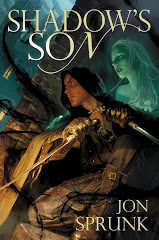
Cover Illustration © Chris McGrath
Design by Grace M. Conti-Zilsberger


Clay and Susan Griffith are a married couple who have written and published together for more than a decade. Their credits include two novels for Bantam Doubleday Dell in the mid-1990s and another novel for Pinnacle Entertainment Group in 2002 plus numerous short stories published in many anthologies, some featuring noted genre characters like Kolchak the Night Stalker and The Phantom. They’ve also written scripts for television and published graphic novels. The authors have attended many cons over the years and are committed to doing every con they can for Vampire Empire. Visit them at clayandsusangriffith.blogspot.com.

Wednesday, July 7, 2010

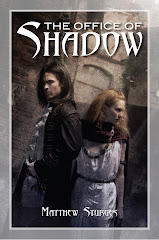
The Office of Shadow by Matthew Sturges

Midwinter has gone, but that cold season has been replaced by a Cold War in the world of Faerie, and this new kind of war requires a new kind of warrior. Seelie forces drove back Empress Mab at the Battle of Sylvan, but hostilities could resume at any moment. Mab has developed a devastating new weapon capable of destroying an entire city, and the Seelie have no defense against it. If war comes, they will almost certainly be defeated.


In response, the Seelie reconstitutes a secret division of the Foreign Ministry, unofficially dubbed the “Office of Shadow,” imbuing it with powers and discretion once considered unthinkable. They are a group of covert operatives given the tasks that can’t be done in the light of day: secretly stealing the plans for Mab’s new weapon, creating unrest in the Unseelie Empire, and doing whatever is necessary to prevent an unwinnable war.


“A book this good, that breaks so many rules, should be illegal. A novel should not be allowed to mix high fantasy and cold war thriller, throwing together ancient gods, magic-wielding spies, sorcerous super weapons, and political machinations. Matthew Sturges, however, combines all these elements and sets them off like one of the book's spellbombs. The Office of Shadow [excerpted below] is a fast-paced adventure that is outrageously entertaining, and like nothing you've ever seen.”
—Daryl Gregory, author of Pandemonium and The Devil’s Alphabet


The Office of Shadow
Matthew Sturges


Part One

Uvenra slept among the ash at Belekh; the daughter of Uvenchaud was dead by the hand of Uvenchaud and slept among the ash. For a week and a day the king wept. Then Uvenchaud took his chariot and drove it to Prythme, where the gods dwelled. To confront the gods he went there. He shook his sword at the gate; he shook his shield at the gate. Uvenchaud struck the earth with his sword and the earth trembled. The gate opened. At Uvenchaud’s threat did it move upon its mighty hinge.

Uvenchaud went into the courtyard at Prythme. In the courtyard Uvenchaud called out. “I am Uvenchaud, whose fist is iron, who united the wild Fae clans; the Fae clans have submitted to my will. As the ruler of them I demand parley.”

Uvenchaud stood in the courtyard for a week and a day. For another week and for another day he stood and there was no answer. Uvenchaud struck the earth again with his sword and called out. One of the gods came. The bearded god Althoin, god of Wisdom whose Gift is Insight, came to match his wits against Uvenchaud.

“Why do you come here?” said wise Althoin. “Why does Uvenchaud come here to disturb the thoughts of the gods?”

“Uvenra my daughter sleeps among the ash. She is dead by my hand, for she betrayed me to my enemy
Achera, the dragon who has slain many.”

“You have come here to be judged by the gods.”

“I do not come to be judged by the gods. I come to defy the judgment of the gods.”

Althoin spoke. He said, “You cannot escape the judgment of the gods. We are seated above you to judge you and to command you.”

“Who seated you there?”

“We seated ourselves.”

“Then I will unseat you.” Uvenchaud struck the earth with his sword, and the god laughed at the sword.

“You cannot kill a god,” said Althoin.

Uvenchaud struck at Althoin for a week and a day. After a week and a day he stopped and Althoin was
unharmed. “You cannot kill a god,” said Althoin.

Ein, god of War, whose Gift is Leadership, came to match his strength against Uvenchaud. For a week and a day Uvenchaud struck Ein with his sword. For a week and a day they struggled, but Ein was not slain.

“You cannot kill a god,” said Ein.

“What I cannot kill I can bind,” said Uvenchaud. Uvenchaud had a rope, made of fibers from the tuluk
plant. The rope was dipped in dragon blood. Uvenchaud bound Ein with the rope. Ein strained at the rope, but he was bound.

One by one the other gods came to answer the challenge, and Uvenchaud bound them. He bound Senek. He bound Urul. He bound Penithe and Althoin. He bound Tur and Loket. Obore and Reinul he bound. Ehreg and Purek he bound.Tenul he bound.

In this way did Uvenchaud bind each of the twelve gods at Prythme.

In Prythme the gods lie. In Prythme they are bound.

In Prythme they are held by tuluk fibers and dragon’s blood.

No god judged Uvenchaud for the slaying of Uvenra.

—from The Chthonic Book of Mysteries, translated by Feven IV of the City Emerald


chapter one

The sun in Annwn perches eternally on the horizon, swimming in lazy circles that allow it to fully rise for only three hours each day. Never lighter than morning nor darker than dusk, Annwn exists in perpetual transition—always arriving, never arrived.

Annwn was discovered by the Fae long ago and was, for many centuries, a bastion of the pure Elvish folk. But it was later discovered by men from the Nymaen world, those called human, and conquered by them. Over time the two races mingled, and have now become one. Neither Fae nor Nymaen, they are simply Annwni,with some of the qualities of each.

There are many villages in Annwn, but only one city, named Blood of Arawn. The city is built upon seven great ramparts of earth and stone dug out of the otherwise flat grasslands of that world. The oldest buildings of that city—the coliseum, the Penn’s villa, the temples—are built of marble, but many of these structures have since crumbled and have been replaced with more modest structures of brick. Only the obelisk at the center of the great market, called Romwll’s Needle, remains unblemished
after fifteen centuries. Conventional wisdom holds that a pair of thaumaturges sit in a stone room beneath the obelisk, whispering bindings without cease, for it is believed that if the needle were ever to fall, then Blood of Arawn would fall soon after, and all of Annwn crumble into dust.

—Stil-Eret, “Light in Annwn,” from Travels at Home and Abroad


Five Years Ago

The flashes of witchlight began to streak the horizon shortly after midnight and continued through the night, growing closer by the hour. Paet ran through the dappled darkness, ignoring the sky.

The attack had come as no surprise to anyone, but Mab’s Army had beaten even the most alarmist estimates in its timing. Back at the Seelie Embassy, the packing and burning of documents, which had begun in an orderly fashion three days earlier, had become a frenzy of activity. Bags were hurriedly packed; valuables were sewn into the linings of garments; empty kerosene barrels were stuffed with dossiers and set aflame.

None of this was of any concern to Paet.

Blood of Arawn was an ancient city. Not as old, perhaps, as one of its Seelie counterparts, but it appeared much older as a result of governmental indifference down the ages. The cobbles in the streets were uneven, some missing, and Paet could hear carts and carriages jouncing across them in the street beyond his darkened alley. He could also hear shouts and occasional shrieks, as certain of the populace considered the reputation of the encroaching conquerors and decided not to take their chances. Paet could hardly blame them; life under the Unseelie was certain to be a disappointment for those who decided to stay.

A group of a dozen Chthonic coenobites clattered past Paet, their faces calm, their legendary indifference suiting them well this night. Their saffron-dyed robes brushed the cobblestones, the bells sewn into their fabric quietly jingling. As the state religion in all but name, the Chthonics would be allowed to continue so long as they acknowledged Mab as a goddess, and superior to their own. This the Chthonics would happily agree to do, praising Mab publicly and ignoring her in private. Their own deities had been subdued eons earlier and could scarcely take offense. Or so the stories went; Paet had no use for religion.

There was a scintillating flash in the sky. A moment later the ground shook and Paet stumbled. He stopped and listened as the low rumble of reitic concussions echoed down the alley.Waves of heat from the battle outside had begun to roll over the walls before Paet had left the embassy, and now the city both felt and smelled like a tavern kitchen: stifling, stinking of sweat and overripe food. Paet felt the prickling of perspiration beneath his heavy linen shirt. He continued running.

The district of Kollws Vymynal covered the smallest of Blood of Arawn’s seven hills. The East Gate was set into the wall at the foot of Kollws Vymynal, which put it closest to the fighting outside. Here Paet could just hear the clash of blades and the shrieks of horses and men mixed in with thundering hooves and reitic blasts.

How long had it been since he’d left the embassy? His internal time sense told him it was only about twenty minutes. That gave him just enough time to retrieve Jenien and make it to the Port-Herion Lock before the Masters shut the thing down, stranding them in Annwn. Not the end of the world, but close enough.

The streets of Kollws Vymynal twisted and doubled back upon themselves, and what signs existed were printed in tiny ancient script that beggared deciphering. The district’s inhabitants had either bolted themselves inside their homes, drawing the curtains and shutters tight, or had joined the frantic knots of refugees. Most were headed toward the Southwest Gate, which meant that Paet was fighting against their current. From the city they would beg passage to a different world or strike out southward, hoping to disappear into the plains villages.

The clock in a nearby Chthonic temple struck three and Paet whispered a curse. This was taking too long.

Paet finally found the address he was looking for at the end of a small culde-sac, a four-story tenement that smelled heavily of burnt cooking oil and pepper and rot. This was the address Jenien had written down in her logbook when she’d left the embassy that morning, long before word of Mab’s invasion
had reached the city. Just the address and a name: Prae Benesile. All she’d told Paet was that she was going to visit a “person of interest,” which could mean just about anything. By nightfall, while Blood of Arawn convulsed in preparation for its imminent surrender, she still hadn’t returned. Paet had waited for her until he could wait no longer and had then gone after her.

“We won’t hold the lock for you,” Ambassador Traet had told him diffidently. Everything about Traet was hesitant and noncommittal; his appointment had been a sinecure, and laughably so. In happier times, Annwn had been a cozy assignment. Now Traet was in over his head, but at least had the
sense to realize it. “If you’re not back by sunrise,” Traet had said, stuffing a valise haphazardly with documents, “you’re on your own.”

Paet breathed deeply ten times. He consciously slowed his heart and forced out the remainder of the prickly heat that filled his blood. The fear of the body could be controlled easily, but for the fear of the mind there was no cure. Only action, despite it.

At the end of the street someone smashed the window of a bakery and grabbed a basket of bread amid surprised shouts.

Paet let himself into the tenement building and hurried up the stairs, making no sound that any Fae or Annwni could hear; of course, the things he was most concerned about were neither, and had excellent hearing. Still. The stairway was filled with cooking smells and body odor. When he reached the third floor he stepped carefully out of the stairwell. The narrow hallway was empty; several doors along its length were open, their inhabitants apparently not seeing the point of locking up behind them. Many of the older, poorer residents of Annwn had fought against Mab’s Army in the Sixweek War twenty years previously, and had apparently had enough of the Unseelie for a lifetime.

The apartment Paet was searching for was near the end of the hall. Its door was open as well, though light still burned within. Paet took a long, serrated knife from within his cloak, testing the blade with his thumb by force of habit. He pushed the door open gently and waited, listening. His hardlearned
caution warred in his mind with his sense of urgency. If ever there was a time to take a risk, this was it. He swore under his breath and stepped into the apartment.

It was small, a single room lit by a lone witchlamp sconce set into the wall. The long-untuned bilious green light cast harsh shadows over the furniture, placing imagined adversaries in every corner. A tattered cot slumped beneath the waxed-paper window. A chipped chamber pot sat in the corner.
Books and bits of paper and parchment were everywhere, piled on the floor, leaned in uneven stacks against the wall, scattered across the cot. There was no sign of Jenien.

Stop and think. Breathe. Relax and smooth the edges of consciousness. Paet picked up a book at random and opened it. It was written by Prae Benesile himself, a work of philosophy, something to do with the history of the Chthonic religion. He put it down and picked up another. This one was a collection of Thule religious poetry, prayers to the bound gods, hymns of supplication, prophecies of liberation and doom. A sampling of the rest of the books revealed most of them to be of a kind: works of philosophy, sacred texts—many regarding the Chthonics, but also some Arcadian scrolls, a few
codices from the Annwni emperor cult. Some were written in languages that Paet didn’t recognize. There was nothing here to indicate that Prae Benesile was anything other than a reclusive scholar.

Paet sniffed. Blood. Blood had been spilled in this room, and recently. He knelt down and examined the dusty floorboards. Too many shadows. Paet glanced toward the window, shrugged, and created a stronger, pure white witchlight that suffused the entire room. The blood on the floor was tacky
and brown, smeared in a scuffle. Paet heard the choking cough from beneath the cot just as his eyes followed the trail of drying blood toward it. He tested his grip on the knife and then channeled Motion and drew the cot quickly backward with a twist of his mind.

Jenien lay curled in a fetal position, clutching her abdomen, breathing raggedly. She looked up at him, and her eyes went wide in her pale face.

~~~

“Watching,” she whispered. “Bel Zheret are here.”

Paet’s heart leapt forcefully at the name. He stood and whirled, brandishing the knife. Nothing moved.

He turned back to Jenien and knelt before her. “If they were here I either slipped past them, or they’re long gone.

“Said they’d be back for me,” Jenien wheezed. She was having trouble breathing. Paet gently pulled her hands away from her belly, pulled aside her shredded blouse. Jenien was going to die; there was nothing he could do for her. These were wounds that not even a Shadow could recover from.

Paet found a pillow on the overturned cot and put it under Jenien’s head. Her hair was wet with perspiration. She reached for his wrist and grabbed it with weak fingers.

“Mab’s coming,” Jenien observed. “Thought we’d have a few more days.”

“Things at the embassy have become frantic to say the least.”

Jenien chuckled softly. “Traet running around like a headless chicken?”

“Yes.”

“Is that knife sharp, Paet?” she said after a brief pause.

“I’m getting you out of here,” he said. “Just rest a moment longer.”

“Remember that night in Sylvan?” she asked. She was starting to slur her speech. Her body trembled. “The little theater with the terrible play?”

“I remember,” Paet said, smiling.

“I bet if we were normal we could have fallen in love that night,” she said, sighing.

Paet felt his emotions receding as she spoke. The world became flat. Jenien was an object; a bleeding thing with no impact. A problem to be solved. Was this lack of feeling something he’d always had, or something he’d developed? He couldn’t remember. Had he become empty like this when he became a Shadow, or was it the emptiness that qualified him for the job? It didn’t seem to matter.

“It was the mulled wine,” he said, sitting her up. “It was strong. Hard to tell through the cinnamon and cloves.”

She winced as he maneuvered himself behind her. “You looked very dashing. You had one of those red cloaks that were so popular back then.”

“Just blending in,” he said. Then, after a moment, “What was so important about Prae Benesile, Jenien?”

She shook her head sadly, worked to speak clearly. “Someone from the City of Mab had been to see him. Five times in the past year. I was just curious. Bel Zheret showed up when—” She winced.

Paet brought up the knife. “They take him?”

Jenien nodded. “He struggled; they killed him.”

“Ah.”

“I don’t want to die,” she said. It was a statement, merely an observation.

“We’ve been dead for a long time,” he whispered in her ear. He drew the knife across her throat in a quick, sure motion, and pulled her neck back to hasten the bleeding. She shook; her chest lurched once, then twice. He waited until he was certain she was dead, checking her eyes. He looked into them
until all the life had gone out of them. It took time. Dying always took time.

Paet took a deep breath and braced his knee against her back. He put the serrated blade of the knife to Jenien’s throat again, using the original cut as a guide. He buried his other hand in her hair and pulled, hard, as he began to saw.

Ligament popped. Metal ground against bone. With a sickening crunch, vertebrae parted. A few more strokes and the remaining skin tore loose soundlessly. Jenien’s head swung obscenely in his grasp.

He laid it gently on the floor and reached into his cloak. Among the few items he’d brought with him from the embassy was a wax-lined canvas bag, for just this purpose. He unfolded the bag and placed Jenien’s head, dripping with blood and sweat, gently inside.

That’s what you got for being a Shadow.

~~~

He didn’t hear them so much as feel the disturbance of the air as they flowed into the room.

Paet turned and saw two tall, dark figures flanking the door. For an instant they looked as surprised as he, but to their credit, they recovered more quickly than Paet did. The first one had his sword out before Paet could begin to react.

Paet stepped back, feeling the position of the corpse behind him and moving easily around it. He stepped into a ready stance, his knife already warm in his hand.

The first swordsman closed on Paet, and Paet got a good look into the man’s eyes. Black, empty black, stretching inward to infinity.

Bel Zheret.

Paet was a dangerous man. But going up against two Bel Zheret in a closed space was suicide. He backed up, toward the dingy window of waxed paper.

“You’re a Shadow, aren’t you?” said the first swordsman. He smiled pleasantly. “My name is Cat. It would be my sincere pleasure to kill you.”

“It would be my sincere pleasure for you not to.”

“Just so. But I must insist. I have never killed one of you.”

Oh. In that case I’m not going to fight you,” said Paet, sheathing the knife.

The Bel Zheret stopped short, flicking his blade in the air. The grin faded, replaced with sincere disappointment. “Why not?”

“If I’m going to die anyway, I’d prefer to give you neither the pleasure nor the experience of engaging me in combat. The next time you come against a Shadow, I’d prefer that you have no personal knowledge of our tactics, our speed, or our reflexes. That way, you can be more easily defeated then
by one of my colleagues.”

Cat pondered this, never taking his eyes off of Paet. “Well,” he said, shrugging, “we can still torture you.”

He waved the other Bel Zheret forward. “Restrain him, Asp,” he said.

Asp moved with astonishing fluidity and quickness. He didn’t seem to tread through the room so much as unfold across it, his limbs elastic, perhaps even multijointed. No matter how many times Paet saw this skill employed, it unnerved him.

Paet took a deep breath and unsheathed his knife again, rearing back for a sudden forward attack against Cat, carefully weighing the cloth bag in his other hand. Cat prepared to block Paet’s attack, but no attack came. Paet instead added to his rearward momentum by shoving off with his back foot,
launching himself toward and through the window. The third-story window.

Falling backward, unable to see the ground, Paet considered his chances for survival. The descent seemed to go on for eternity. He concentrated and slowed his heart again, deliberately let his muscles go slack. He even willed his bones to soften and become more flexible, though he had no sense of
whether it was a good idea, or whether it would even work.

Finally, he hit the cobblestones on his back, at the angle he’d desired. Jenien’s head made a sick, muffled thump as it struck. In his hurry, Paet had forgotten the knife in his left hand, and felt the snap of his wrist as it was wrenched by the hilt’s impact. How many of Paet’s wrist bones broke simultaneously he couldn’t guess. More than one. There was no pain yet, but that would come in a few seconds.

More prominent at the moment were the pain along his spine and his inability to breathe, the sharp crack of his skull against stone. So perhaps not exactly the angle he’d intended. He was still alive, however, and his legs felt fine; that was all that mattered.

Paet climbed slowly to his feet, looking up at the window. Cat was already drawing his head back inside the room. The waxed-paper windowpane fluttered down crazily in the shifting breeze of the cul-de-sac. He could already hear the steps on the stair, Asp already dispatched. He picked up the sack containing Jenien’s head and ran.

Blindly at first, Paet raced out of the cul-de-sac and turned right, for no particular reason. He would need to make his way back west, but not by the most direct route, nor by the most secretive. He would have to split the difference, taking random turnings and inconvenient doublings in order to throw off a pair of Bel Zheret, who would already be considering all of the things that Paet was currently thinking. They outnumbered him, they weren’t fleeing, and neither of them had just fallen out of a third-floor
window. These were tangible assets that Paet couldn’t at the moment figure out how to turn into disadvantages. On the positive side, the night that he fled into was growing more chaotic by the minute.

He kept running, the ringing in his ears from the fall replaced by the sounds of battle, ever closer, the clatter of feet and hooves on stone, shouting. He smelled smoke; somewhere nearby a building was burning. On some of the faces he passed, worry was being replaced with panic. The Unseelie were no longer coming; they were here. Life in Annwn was about to change significantly.

As Paet turned another corner into the wide avenue leading back toward Kollws Kapytlyn, his left hand, still somehow grasping the knife, slammed hard into the post of a pottery merchant’s cart being pushed in the other direction. His vision dimmed and his gorge rose as the pain from the broken wrist leapt up his arm, into his brain and then his stomach. Continuing to run, though slower, he considered dropping the bag. He couldn’t defend himself while he carried it.

Looking back, he saw Asp now entering the market from the same alley that Paet had. The Bel Zheret caught his eye and moved toward him, shoving a fruit vendor’s cart aside with a strength that made Paet wince. Empress Mab’s operatives were getting stronger, faster, more intelligent. Whatever the black art was that grew them in the bowels of her flying cities, it was improving with every year.

So there was one. Where was the other one? Had he run ahead, plotting a tangential course, or was he behind the one he’d just seen? Which had been at the window? Which at the stairs? In the pain and hurry, Paet couldn’t remember.

Scattered thinking kills quicker than poison. That was one of Master Jedron’s favorite adages.

Paet ducked into a doorway and risked closing his eyes just long enough concentrate and cut off the pain from his wrist, slow his heart, and clear out the essence of fear in his blood. Better to lose a moment of his head start than to give up his mind to panic and pain.

Again he ran, now turning into a blind alley that was dark and cool, the walls close together. It was quieter here; the commotion beyond became a homogenous roar. The smell of smoke, though, was stronger. Nearer the fire.

Condensation dripped down the moss-covered stones. Though Paet knew Blood of Arawn well, and had spent hours poring over maps a few days earlier, he wasn’t exactly sure where he was at the moment, or whether this alley would take him to another street or to a dead end. Still, it was the unexpected thing to do, and that was his primary defense at the moment.

The alley opened on a wide street, and Paet hurried into the center of the city, where the giant obelisk atop the Kapytlyn rose up and vanished into the blankness of night. Asp was nowhere to be seen. The crowds were thicker here, the city’s dependents waiting for news or instructions. Paet knew that those instructions wouldn’t come until Mab’s officers took control of the place. The rightful governor was long gone, having taken refuge in the Seelie Kingdom earlier that day, along with a score of top officials. Most everyone else in government had already fled to the countryside.

Paet stopped a moment to get his bearings—he’d actually been running away from the Port-Herion Lock, not toward it. Inwardly cursing himself, he turned and began again. Thankfully the chaos surrounding him, which would normally have been a hindrance, worked in his favor. At any other
time, a limping, sweating Fae brandishing a bloody knife would undoubtedly be noticed. The first rule of Shadows was to draw no attention; that was the ostensible meaning of the nickname. Though not the true one.

Paet breathed deep and concentrated again, hoping to heal the wrist enough to fight. He was running low on re, having used up much of his stored magical essence in his various reachings-in today. He did the best he could, then headed toward a side street that led to the Kollws Ysglyn, and the Port-Herion Lock beyond.

The Bel Zheret named Cat was there waiting for him, sword drawn.

Paet dropped the bag and rushed him, praying that his momentum would be enough to take the man down, but the Bel Zheret stayed on his feet and, though unable to bring his blade to bear, punched Paet hard in the stomach. There was something on his hand, turning his knuckles into spikes, and the Bel Zheret twisted those spikes into Paet’s midsection, not hard enough to draw blood through Paet’s cloak, but still painful.

Paet pulled back, stepping hard on the side of Cat’s knee, a lucky move, and the Bel Zheret crumpled, falling backward against the wall. Paet knew from experience that having your knee kicked out of its socket was one of the more painful things that could happen in a fight, short of being run through, and he was amazed that Cat was still standing, let alone continuing to swing his blade.

For an instant, fear tumbled into Paet’s mind and he was certain that he was going to die. Right here in this alley, carrying the severed head of a woman with whom he’d once made love. All his regrets spilled onto the dank cobblestones. Where was Master Jedron with a homily against the inevitability
of death? Certainly one existed, and it was something stoic and tough. Well. Better to die here in an alley than in a dimly lit room with the Bel Zheret. They would torture him slowly and effectively, and despite his training they would cut his knowledge out of him. With their teeth.

There was a sound in the alley. A pair of burly city guards were approaching, their clubs out and ready. Both looked tense and afraid. They’d been given instructions to remain and to keep the peace until the bitter end. Neither one appeared happy about it.
Cat spun Paet around and shoved Paet’s face hard against the wall. A knife pierced his back, went deep, and Paet felt something in his body give. A kidney? The knife traced a path across his back and caught on something hard, a vertebra. With Paet’s enhanced sensitivity toward his own body, he felt it in excruciating detail, felt the nerve tissue shredding like spiderweb. Another hard shove and Paet’s nose smashed into the bricks of the wall.

Paet slid down the wall and watched Cat begin a methodical slaughter of the two guardsmen, who barely had time to shriek before he began hurting them. One of the Bel Zheret’s few weaknesses was that they took a bit too much pleasure in causing pain; perhaps it was an unintended side effect of
whatever it was that created them. Perhaps, worse, it was intended.

With the very last of his re, Paet attempted to repair those nerves, to find his way into the kidney and send healing toward it. These were still killing wounds, but perhaps they would kill a bit more slowly now, and give him time to reach the lock before he died. Paet now reached out, out of his body and out into Blood of Arawn, looking for life, looking for re that he could steal. Two children in an adjoining house, huddling in bed. He drew as much from them as he could without killing them. They’d be sick for a few days, nothing more. It would be the least of their worries. He would kill the children if he had to, but not unless it was absolutely necessary. And it wasn’t absolutely necessary. Not yet.

While the Bel Zheret continued its work on the guards, Paet exited the alley in the other direction as silently as possible, picking up the bag as he ran. The knife wound seared through his back, making the broken wrist seem mild in comparison. He could sense fluids in his body mixing that should not
mix, blood leaking into places where blood did not belong. Despite his best efforts, he might not make it.

Again he considered abandoning Jenien. A loose cobblestone would do the trick, crush her brain until it was utterly unreadable. But he couldn’t do it. Killing her had been bad enough. Nor could he simply toss the cloth bag into one of the now-many burning buildings that lined the street along which he staggered.

A clock in the main temple struck the hour, and Paet felt what blood remained in him drain toward his feet. The Port-Herion Lock would be shut down soon. Any minute now. They would not wait for him.

Running. Breathing hard in his chest. Now no longer caring whether he was seen or what kind of impression he made. Get to the gate, through the lock, onto Seelie soil. This was all that mattered now.

There was a side street that ran along the base of Kollws Kapytlyn, where the Southwest Gate stood, and Paet reached it, out of breath, after what seemed like hours. The street was empty. It ran along a ridge line, overlooking the endless prairies of Annwn. In the distance, one of the giant, tentacled boars, the Hwch Ddu Cwta, raised its head to the sky in the dark, amidst the noise.

Paet’s legs felt like they’d been wrapped in cold iron; his breath came like knife thrusts. Blood dripped down his back, thickening along the length of his thigh. He stumbled once, then again. He should have killed those two children; it had been necessary after all. He was sworn to protect the children of the Seelie Kingdom, not the children of Annwn.

He struggled again to his feet. The pain in his back, in his chest, in his wrist—they all conspired against him, hounding him. Each had its own personality, its own signature brand of hurt.

The city gate was up ahead, left open and unguarded. Beyond he could see the lock glowing in the distance. The portal was still open!

One of the Bel Zheret tackled him hard from behind, his shoulder biting into the knife wound. The bag containing Jenien’s head tumbled away. Whether his attacker was Cat or Asp he couldn’t tell; not that it mattered now. If it was Cat, then he’d get his wish to kill a Shadow after all.

But he wouldn’t get Jenien. Paet crawled toward the bag, allowing the Bel Zheret free access to his back, which his assailant readily exploited, kicking him hard in the kidney.

Paet collapsed on top of the bag and, with the last of his strength, crushed Jenien’s skull with his hands. It was harder than he would have thought. Mab wouldn’t learn any of her secrets now.

The Bel Zheret knelt over Paet and began delivering efficient, evenly timed blows to Paet’s spine, then turned him over and dealt equally with Paet’s face. Paet felt his nose crack, his lower jaw split in two. Teeth rolled loose on his tongue; he swallowed one. He felt ribs crack, first one, then two more. Something popped in his chest and suddenly he could no longer breathe. There was no sound except the dull rush of blood in his ears. The world spun; the beating, the pounding receded, then faded altogether.

~~~

A few minutes later Traet, the Seelie ambassador, followed by a pair of clerks lugging baggage and valises thick with papers, literally stumbled over Paet’s body.

“Oh, dear!” Traet cried. “How awful!”

“Is he alive?” asked one of the clerks, kneeling.

“We don’t have time for that,” Traet muttered, walking past. “There will be casualties.”

“Sir, it’s Paet!”

The ambassador quickly turned, his eyes wide. “Gather him up, then! Quickly!”

The kneeling clerk felt for a pulse. “He’s dead, sir. Perhaps we oughtn’t to bother. . . .”

“Don’t be a fool,” said Traet. “Hand me your bags and take him. Now!”

Neither the clerks nor Traet noticed the cloth bag that had fallen from Paet’s hand, now resting in a clump of bushes just outside the gate.

Once the ambassador’s party was safely through the lock, the Master of the Gates opened a small door on the side of the massive portal. He adjusted the ancient machinery, and a loud hum joined the cacophony of flames and the percussion of war from across the city. While a sextet of extremely fiercelooking members of the Seelie Royal Guard held back the small knot of would-be refugees that had surrounded the lock, the Master closed the door, carrying a heavy part of the lock’s inner workings with him. He stepped through and beckoned the guardsmen to follow. They backed slowly into the silken portal, not so much disappearing as gliding out of existence. The tips of their swords were the last things to vanish. The instant the last of them was through, the portal went dark, revealing behind it only a veneer of highly polished black stone. The desperate crowd banged their fists against it, some weeping, others shouting.

Just before dawn a tocsin sounded in the city and the Unseelie flag was raised upon the obelisk. All was quiet. The crowd at the Port-Herion Lock hesitantly turned away from the dead portal and went their separate ways—some back into the city, their heads hung low; some out into the pampas, not
looking back.


chapter two

Titania is the land and the land isTitania. She reads the song of birds and feels the brush of the plow upon her skin.

—Anonymous, “Ode to Titania”


Today

Regina Titania, Fae Queen of the Seelie Lands, Purest Blood of Pure Elves, sat upon her stone chair, chin in hand, swinging her feet. The lights were dim in the throne room, and the sound of her heels clicking against the floor echoed in the gloom.

She looked at her husband, King Auberon, the son of Aba himself, who slouched insensate in his own seat. He had not spoken in centuries, not since she had stolen his power and his mind on the day of their marriage.

“A change approaches, husband,” she said softly. “Long ago you warned me this day would come, and I scoffed. Now I stand chastened.”

Auberon’s head lolled to the side, and he sobbed quietly.


chapter three

All Gifts are Gifts of Aba, who is God beyond gods. To him who sees clearly, this is not a matter of faith; it is axiomatic.

—Alpaurle, The Magus, translated by Feven IV of the City Emerald


Silverdun sat in the antechamber to the abbot’s office, shivering. Tebrit had forced the novice robes over Silverdun’s head without giving him the opportunity to dry off first. He was dripping onto the floor.

After a few minutes, Abbot Estiane opened the door to his office and ushered Silverdun in, groaning at the sight of him. The office was cramped, but warm—the abbot was allowed a small brazier in his office, due to his rheumatism. Or, at least, that’s what he told everyone. Silverdun knew, however, that
Estiane simply didn’t like to be cold, and had, in his words, “spent enough years as a coenobite freezing my ass off for no reason.”

Estiane said nothing for a minute or two, busying himself with digging through the dozens of scrolls and books littering his desk for something in particular, then giving up and reaching beneath the desk for a metal flask, which he unstoppered and handed to Silverdun.

“Here,” he said. “This’ll take the edge off.”

Silverdun took a pull from the flask and was rewarded with a swallow of some of the best brandy he’d ever tasted. “The queen’s tits, Father, where did you get this?”

Estiane smiled. “We all have our little secrets, Silverdun. Do you think I’d still be running this place after all these years if I didn’t have a few strings to pull?”

Silverdun nodded and took another sip.

“You’ve pissed off Tebrit again, I see,” said Estiane.

“Not a difficult task.”

“Missed morning prayers, did you?”

“I think it was the hangover in particular that got me sent up to you.” Silverdun shrugged. “Just between you and me, I don’t think Tebrit likes me much.”

Estiane waved the thought away. “Nonsense. Tebrit is simply fulfilling his obligations as Prior to ensure that your novitiate is a period of cleansing, separating you from the things of the world in as complete a fashion as possible.”

He took the flask back from Silverdun and had a nip from it himself before returning it to the desk. “Oh, who am I kidding? The man despises you. And with good reason.”

“I don’t think it’s very holy of him to take such pleasure in it.” Silverdun sniffed.

“Allow the man his small comforts. He has a very difficult and thankless job. Believe it or not, you’re far from the least holy novice that’s ever passed through this temple.”

“Oh, really?”

“I was much worse. Why, during my novitiate I actually snuck a pair of twin sisters into the sacristy and got them drunk on the holy wine.”

Silverdun slapped the desk. “You cad! And they still ordained you?”

“They never found out.”

“I knew there was a reason I liked you,” Silverdun said. “Well, I suppose

you’ve got to punish me. Garderobes for a month, is it?”

“Two, actually. One for missing morning prayers and one for drinking in the presence of your abbot.” Estiane smiled and leaned back in his chair. “Ha! Didn’t see that one coming, did you?”

“You old bastard. How you ever got to be a religious leader is beyond me.”

“It’s simple, really,” said Estiane, leaning forward, the smile fading. “Look around you. Do you see any parishioners? Any lost souls other than your own coming to me for spiritual guidance? I’m a civil servant. If I was any good at being religious then I’d be out there practicing religion.” Estiane sighed.
“Being promoted to abbot isn’t a reward; it’s more of a punishment, really.”

Silverdun felt his body finally beginning to warm in the lovely heat of the brazier. “Ah, so you say. But I knew Vestar at the Temple Aba-E in Sylvan. A more holy man I’ve never met in my life!”

What remained of Estiane’s smile vanished and he looked down. “Oh, you had to bring the old man into it, didn’t you, Silverdun? Just when I was having such a lark with you.

“Sometimes we in this business put on a bit of a blasphemous face when we can in order to fend off the ills of the world with good humor. We’re all corrupt in the eyes of Aba, who sees all. But some of us hew very, very close to the ideal. Some of us are so strong that they don’t need any robe betwixt them and the wind. Vestar was one of those.”

“So you admit you’re a lousy abbot,” said Silverdun, smirking.

“I admit no such thing!” said Estiane. “Vestar was a saint. It’s just that there are more churches than there are saints, that’s all. We do the best we can with the gifts we’re given. Most of us are forced to make compromises in order to maintain our sanity. The fact that Vestar never did so is a testament
to his unique virtue.”

“His unique virtue got him murdered,” said Silverdun. “He stood up to Purane-Es when he could have run and saved himself.”

“There’s that,” said Estiane. “There’s that.”

“Will that be all then?” asked Silverdun. “Or do you have any pies or custards hidden back there that I might have a bite of before I head down to the Frater for my morning gruel?”

“As if I’d share my pie with you,” Estiane said, adjusting his robe.

Silverdun stood to go, and the abbot waved him back down again. “Listen, Silverdun. Since I’ve got you here, there’s something I’ve been meaning to discuss with you.”

“If it’s twin sisters you’re after, I’ll need a few days and the key to the sacristy,” said Silverdun.

Estiane said nothing; all the humor had left him.

Silverdun pulled his robes around him. “Well, what is it then?”

“I’ve been debating whether or not to mention it at all, but I suppose it’s best if I do. I’ve received word that Lord Everess would like to speak with you.”

Silverdun sat up. “Really? And how does Everess even know that I’m here? Isn’t my presence here supposed to be something of a sacred trust?”

“Settle down, Silverdun. You must be aware that Lord Everess knows what he wants to know. The truth is, I told him you were here.”

Silverdun scowled. “Why would you do such a thing, Abbot? I don’t want to be involved in the affairs of the world. I just want to be left alone. That’s why I came here in the first place.”

“Yes, and that’s the wrong reason for coming here, and that’s also why you’re such a rotten novice. If it’s solitude you’re after, there are any number of uninhabited islands in the Western Sea you could have chosen.”

“I want to follow Aba,” said Silverdun weakly.

“A man can enjoy telling a joke without joining the circus, Silverdun.”

“What’s that supposed to mean?”

“It means that just because you want to please Aba doesn’t mean you have to become a monk. And you know it.”

“Enough, enough. What does any of this have to do with Everess? What does he want with me?”

“I’ll let him tell you,” said Estiane. “And I suggest you hear him out. Now shall I let him know you agree to see him, or shan’t I?”

Silverdun thought in silence. The fog in his head was lifting, but his mind didn’t want to think—it wanted to be carried off by the warmth into a comfortable silent place. This was, he thought ironically, the closest thing to true prayer he’d experienced since coming to the monastery.

“Fine. I’ll see him,” said Silverdun. “But I reserve the right to ignore everything he says.”

“Excellent,” said Estiane. “I’m glad you feel that way, since I already invited him. He’ll be here tomorrow.”

Silverdun glared at the abbot. “You really are a bastard, you know.”

Estiane’s smile returned. “I believe you’ve got some garderobes to clean, Novice. I suggest you get started now, or else you’ll have to spend all of midday prayer smelling like a latrine.”

~~~

The next day was windy as well as cold, and the rain came even stronger. Autumn had settled over the monastery and seemed intent on making its presence known. Thus, Tebrit gleefully assigned Silverdun to the gardens, where he dutifully, if angrily, weeded the cabbage. After an hour his back ached, he was covered in mud up to his shins, and he could no longer feel the tips of his fingers. He tried to stir up a bit of witchfire from time to time, but on each occasion the wind rose up and immediately extinguished it—Aba was watching, it seemed, and wanted to make sure that Tebrit’s punishments
were exacted in full.

The Temple Aba-Nylae stood on a wooded hill just outside the walls of the City Emerald, so there was no protection from the Inland Sea wind that blew over the hill, leaving the grounds wet and cold even when the sun was shining brightly in the city.

Silverdun was down on his knees, yanking away at a recalcitrant root, when he heard a familiar voice boom from across the yard.
“By Auberon’s hairy ass! Is this Perrin Alt, Lord Silverdun, or a rude villein?” The voice then broke out into laughter.

Silverdun looked up and saw Edwin Sural, Lord Everess, standing beneath the cloister loggia, beaming and waving.

“Well, come in out of the rain, Silverdun!” goaded Everess. “I didn’t come all this way to watch you play peasant.”

Silverdun stood slowly, spitting out rainwater. His hair was soaked through, lying in thick tangles around his neck. His novice’s robes, likewise, were drenched, and his hands and feet were thick with mud. He closed his eyes for a long moment before beginning the long squelching trudge across the garden.

“I must say, Perrin Alt,” chuckled Everess, once Silverdun was within easy speaking distance. “I do not think the religious life agrees with you.”

Silverdun had never much liked Everess, who enjoyed his taunts a bit too much for Silverdun’s taste. “One gets used to it,” he said. Whatever witty rejoinder he might normally have come up with was drenched as surely as his witchfires.

“By her teeth, Silverdun! It’s true what I’ve heard—you are changed!” Silverdun automatically touched his face. He could feel the nose, once straight and patrician, now angled with a slight bump. The cheekbones were lower now as well, and the chin not quite so prominent. He had angered the
wrong woman, and she had taken her revenge on his appearance. Faella, the young mestine, who for some reason he could not get out of his mind. Queen Titania had told him that Faella was special, that she possessed the so-called Thirteenth Gift, the Gift of Change. He had a feeling that Titania had not
told him this merely as a point of information.

“It’s the country air,” said Silverdun. “It does wonders for the complexion.”

“Oh, come in out of the wet and stop sputtering inanities.We’ve important business to discuss.” Everess waved Silverdun toward the calefactory, for which Silverdun was inwardly grateful. The warming-room was the only space in the entire monastery in which a fire was allowed to be lit at all times.

They stepped into the calefactory and almost immediately Silverdun’s wet robes began to steam. There was a washbasin filled with hot water in one corner of the room, and before Silverdun could even begin to acknowledge Everess again, he washed his face and hands and feet in the basin, wincing
with pleasure as the feeling returned to his extremities with sharp needles of pain.

The calefactory was empty other than the two of them, which was remarkable for this time of day—it was a rest period, and on a cold afternoon one could expect to find easily half the monks of the abbey clustered here, playing cards, drinking the watered-down swill they called wine, or just sitting idly. The fact that it was empty told Silverdun that Estiane had gone out of his way to ensure that the meeting between him and Everess was a private one.

Once Silverdun felt himself to be sufficiently presentable, he sat down at the long table by the fireplace, where Everess was already seated. Everess had his pipe out and was carefully stoking it.

“I’m pleased that you agreed to see me, Perrin,” Everess began warmly, all trace of banter put aside. “What I have to speak with you about is a matter of great importance.”

“I see,” said Silverdun. “Though I should tell you that I did not, in fact, agree to see you. That bastard Estiane agreed on my behalf without consulting me on the matter.”
“And yet here we are face-to-face, are we not?”

“There’s a fire in here.” Silverdun sighed. He found the repartee tiring.

Everess looked little different from the last time that Silverdun had seen him, which had been in the House of Lords some five years earlier. Still stout and red-faced, with the same bristling brown whiskers spotted with gray. His eyes were narrow and partially hidden beneath bushy eyebrows, giving him a permanent squint. He sucked on his pipe, and a small tendril of smoke emerged from it. Silverdun waved a finger at the smoke, and it formed itself into interlocking rings, twisting and spinning up toward the ceiling.

“Oh, do stop fooling around, Silverdun,” said Everess. “There’s much to discuss, and I’d like to get back to the city before the road out there washes out entirely.”

“You have my complete attention,” said Silverdun.

“It’s time for you to come out of hiding,” said Everess. “I understand your need to get away from things for a time, but you’re needed elsewhere.”

“Quite the contrary. I’m happy here.”

“Oh, don’t be stupid, Silverdun. You’ve had your fun playing monk, but that time is over and you and I both know it. You don’t belong here. You never have and you never will. You’re not meant to be confined like this.”

“I was confined for quite a long time at the prison of Crere Sulace. And you never once came to visit me.”

“Yes, and when Mauritane offered you a way out, you took it, even though by all accounts you were riding off to your own death.”

“Mauritane told me he’d kill me himself if I didn’t go.”

“Stop acting like an idiot!” said Everess, suddenly angry. “The point is that you did go. You left Crere Sulace a criminal, and you emerged from the Battle of Sylvan a hero. You’ve proved that you have the ability to do what must be done for the good of the kingdom, and that’s what I need from you now.”

“I disagree. I’m quite content where I am.”

“Really?” said Everess. “Look around you, man. From where I’m standing, all you’ve done is trade one cell for another.”

No witty response from Silverdun’s typically bottomless well of them was forthcoming, so he simply stood and began to turn away.

“Come into the city, Silverdun,” Everess called after him. “Hear what I have to say. And then if you don’t like it, you can come back here and keep rotting for all I care.”

That stung.

~~~


A messenger on a sturdy mare watched Lord Everess’s carriage vanish into the rain from the hilltop overlooking the temple. Once he was certain that Everess’s departure was assured, he gingerly walked the horse down the grassy slope to the temple’s stable.


He handed the reins to a passing monk, assuring the man that he’d be back momentarily. Good to his word, a few minutes later, he returned from the monastery, mounted, and rode off without another word.

~~~
Silverdun left the calefactory feeling warm, but also a bit dizzy. He and Everess had never been friends—they’d known each other in passing in the halls of Corpus, and Silverdun’s second cousin had married a nephew of Everess’s, but Silverdun hadn’t even attended the wedding. So why was Everess coming for him now?

Silverdun sneaked carefully through the refectory and back into the dorter. All of the monks’ rooms were empty now—rest period was over, and afternoon prayers had already begun. Silverdun couldn’t have cared less. He sunk onto his cot and leaned against the wall, letting the cool stones calm him.
On a shelf above the bed was a duffel bag that contained the day suit he’d worn when he’d entered the place ten months earlier. It had been washed and pressed. His boots, polished and supple, were lined carefully next to the bag, and beneath them both was the sword that Mauritane had presented him at
the celebration following the Battle of Sylvan. Engraved in the blade was the Silverdun crest surrounded by five stars: one for each of his companions on the journey that had led him out from exile at Crere Sulace and back into life.

Of those five, two were dead: Honeywell had given up his own life to save them at the beginning of their journey. Gray Mave had betrayed them, and died for his sins. Brian Satterly was off somewhere rescuing human babies from Changeling traders, and good riddance. Raieve, now Mauritane’s wife, had returned to Avalon to help win the peace there. Mauritane was on leave from his post as captain of the Royal Guard, no doubt fighting alongside her.

Or so he believed. He hadn’t seen anyone from his former life in months. He missed them. He even missed the foolish human Satterly. That was depressing.

There was a knock at the door and Silverdun braced for another assault by Tebrit, but instead it was Estiane who stepped into the cell. The abbot shut the door quietly, an odd expression on his face. He held an envelope in his hand, and Silverdun recognized the broken seal as that of Marcuse, the queen’s chamberlain. Estiane sat at the edge of Silverdun’s cot, turning the envelope in his fingers. He held it delicately, as if it were a dried flower or a piece of fine china.

“Let us be perfectly honest with one another, shall we?” said Estiane. “No banter, no gamesmanship. No hidden agendas.We are both men of Aba, who do our best to serve the Good, and often fail miserably along the way. Agreed?”

Silverdun sat up. A witticism reared up in his mind and he choked it down. “Fine,” he grunted.

“I know why Everess came to see you today,” said Estiane. “He and I have had a number of rather serious conversations over the past few months.”

“Really?” said Silverdun. “Is Everess an Arcadian? He never struck me as the type.”
“No, no,” said Estiane. “These conversations were of a purely political nature.We don’t like to advertise it, of course, but the Church is as immersed in the world of politics as any other large organization. We have power and influence and knowledge, and it has to be wielded.”

Estiane tapped the envelope gently against his fingers. “As you may know, the Church has a rather sizable network of believers among the Unseelie. Not even we know exactly how many of us there are across Mab’s empire because the Bel Zheret enjoy torturing names out of Arcadians, and we like to offer them as few as possible.

“Much of the useful information our queen possesses regarding the Unseelie comes from us. We have believers at almost every level of government and at every rank in the military. Sometimes their consciences guide them to reveal certain things.”

Silverdun smiled. “And you barter that knowledge for influence at Corpus and with the queen’s court.”

“Of course we do,” said Estiane, his voice rough. “We’d be fools not to. This all has very little to do with serving Aba, but the Church is not itself holy. The Church is an organization that exists in space and time, and it must do what it must in order to survive and thrive. If you’ll recall, when you were a boy, Arcadianism was practically illegal.” Estiane unsuccessfully attempted to hide the guilt he clearly felt. “And that brings us to you, Perrin Alt. Lord Silverdun.”

Silverdun sighed. “I was wondering when something would bring us to me. What’s this about?”

“I’m not exactly sure, to be honest,” said Estiane. “I know that Everess is very keen to bring you back to the capital, but I don’t know why. Something to do with the Foreign Ministry, I should imagine.”

“Honestly, Abbot!” said Silverdun. “Where’s the holiness in that?”

“Holiness?” Estiane hissed the word. “Holiness is a privilege granted to blessed souls like Tebrit, your tormentor. Tebrit doesn’t have to make decisions about how the Church’s influence is used to direct affairs, or whether those affairs ought to be directed, or what the dire outcome for the Church and its followers will be if those affairs are ignored. Tebrit will not have any blood on his hands if a new war begins because there is nothing he could do to help prevent it.

“I, however, am required to make those decisions. There is no way for me to do this without getting blood on my hands. I don’t have the luxury of being spotless.”

Silverdun leaned back again, nodding. “I understand now. Everess needs your information, and you’ve decided to exact payment. He agrees to take me on in whatever role he’s dreamed up for me, knowing that I’ll be acting as your proxy, and in return you’ll provide information.”

“Not just information,” said Estiane.

“Money as well?” Silverdun was shocked.

“We’re being honest, are we not? Silverdun, you don’t read the reports that I read, the list of martyrs’ names that come across my desk day in and day out. The Unseelie take perverse joy in hunting down and murdering Arcadians. What do you think would happen if they were to take down Regina Titania? The Church would cease to exist. Aba’s work in Faerie would be finished.”

Estiane leaned in, and Silverdun could detect the faintest trace of brandy on his breath. “I will not allow that to happen.”
Silverdun stood and pulled his sword down from the shelf above the bed. He unsheathed it and flicked it back and forth in frustration. “And what if I refuse? What if I just want to be a monk?”

Estiane stood and smoothed his robes. “You never wanted to be a monk, Perrin. You just needed a place to hide for a while. Your hiding time is over—I’m kicking you out.”

“You can’t do that!”

“I’m the abbot. I can do whatever I want.”

Silverdun swung the sword harder in the air, striking at an intangible foe.

“Fine,” said Silverdun. “Kick me out. I’ll go back to Oarsbridge and live out my days as an eccentric country gentleman. Find a pretty, dumb daughter of a nearby baron to marry to keep me warm at night. How’s that?”

Estiane smiled. He walked to the door. “It’s not that simple, Perrin. Life never is.”

“It can be.”

“Here,” said Estiane, holding out the envelope. “This was delivered just after Everess left. There were two notes inside. One was addressed to me, the other to you. My note simply asked me to pass yours along to you before I allowed you to leave here.

Silverdun took the envelope, again noting the chamberlain’s seal. Inside was a single sheet, printed in a flowing, beautiful hand. It was not the script of Chamberlain Marcuse. Silverdun knew whose script it was, though. He knew it without needing to be told.

Perrin Alt, Lord Silverdun:

When last we met, I warned you that there would come a time when I would call on you by name. That time has come. Consider well what has been asked of you. You are one who, like a prize racehorse, thrives only when placed upon the track. Go where you will thrive.

The note was not signed, but it didn’t need to be. It had been penned by the queen herself.

“Shit,” said Silverdun. “Shit! Shit! Shit!”

He reached up to the shelf and pulled down his boots.


chapter four

The difficulty, which has yet to be resolved, is as follows. For an Elemental unbinding at a distance, the standard formulation requires the spoken trigger (i.e., the binding word) to interact physically with the binding. Given a distance, d, and the speed of sound, r, the effects of an unbinding word should require time t, where t = d/r. It has been demonstrated in controlled circumstances, however, that the unbinding occurs simultaneously with the trigger.Thaumaturges have debated this question for centuries, but no satisfactory explanation has ever been offered. Since reitic force decreases exponentially over distance, this is rarely a problem in practice. Students are encouraged to use the standard release-chain formulation in most circumstances.

Dynamics, Chapter 7: “Indirect Mechanisms of Release in Distributed Systems”


It was dawn, and Ironfoot was still awake, his head throbbing, poring over the map. The thing was so big that he’d had a local craftsman create a table for the sole purpose of holding it unrolled. It was a topological map, commissioned some number of years ago by a local governor with a penchant for
geography and dreams of wealth from silver mining. The map had been of no use whatever to the governor, save perhaps feeding his ego. But to Ironfoot it had become invaluable.

The readings came in from across the site, and Ironfoot meticulously added them as points of data, using a ruler to draw perfectly straight lines of radiance from one point to the next. A pattern was beginning to emerge, but it still wasn’t enough.

He slammed the table with his fist. Years as a scholar had never tempered the wild part of his nature. He knew it and it infuriated him.

He rubbed his eyes and took a long sip of coffee. His mug had been holding down the lower left corner of the map, and now it tried to roll up a bit. He absently smoothed it with his hands. He reached for the next slip of paper and there were none left.

He stood, feeling the ache in his shoulders and back, feeling the fatigue that flowed through him. He could have himself spellrested by the on-site medic, but that false rest affected only the body and not the mind. He needed sleep. Real sleep.

He opened the flap of the tent and was assaulted by the dusty wind that assailed the site day and night. The dust got into everything: clothes, boots, instruments. Some of it was blown south from the Unseelie steppes, but some of it—and this he tried carefully not to think about—was the incinerated
remains of Fae men, women, and children. The descendants of the founders of the oldest Elvish city.

“Armin,” he called out to his assistant, who stood at the edge of the crater, sipping water from a metal cup. Armin was young, still a student, but already teaching classes of his own at the university and almost certain to be made full professor once they returned to the City Emerald.

“Over here, Master Falores,” Armin said, still looking down into the crater. Ironfoot joined him.

“I wish you’d call me Ironfoot like everyone else does.”

“I’m sorry; my mother wouldn’t approve,” said Armin. He was a careful, dutiful student. It was fine if he wanted to be a bit old-fashioned.

Below, the team of students walked the remaining sections of the site, testing each bit of rubble, bone, and metal. Each student carried an intensity gauge, and every few moments would lean down and carefully take a reading, noting the result on a slip of paper that would go to feed Ironfoot’s map. The
students had caviled at the assignment at first, having not really understood what it was they were volunteering for, but they quickly got over their reservations. The promise of free food and even the smallest of stipends would, Ironfoot was sure, convince any common student to freely give up a limb.

“Shall we have a look?” asked Armin. “See how things are progressing?”

Ironfoot nodded. “It won’t be long now. Another day or two and we’ll have all we can get.”

They had both unconsciously begun breathing through their mouths; they started down into the crater that had, a year ago, been the Seelie city of Selafae.

~~~

There was a peculiar smell down in the crater, one that nobody could quite recognize, though it had components upon which everyone could agree. There was a hint of cinnamon to it, a bit of roasted pork, almost pleasant but undercut with an ugly tarlike stink that lingered in the nose. They’d been here for six weeks and no one had yet gotten used to it. Some of the students wore cloths tied around their faces, but these didn’t seem to help much. A visiting professor of Elements had offered to remove the odor with a simple transmutation, but Ironfoot had refused, not wanting to contaminate the site.

The students and researchers knew better. At Ironfoot’s insistence, not a single breath of re was to be expended at the site. No little luck charms, no cantrips to sing the pain out of aching muscles.

Walking among the ruins, the smell crept into Ironfoot’s senses and he flinched away from it. There was something about it that he couldn’t quite put his finger on, something that might be important. It was a memory, an experience from long ago; he could sense it in the way that any unique smell might recall a memory of younger days, but he couldn’t place it and it was driving him crazy.

“How goes it, Mister Beman?” Armin said to one of the students, a tall pale boy who looked as if he hadn’t had a decent meal since his schooling had begun, and was only now beginning to fill out under Ironfoot’s auspices.

“Coming along, Professor. I hope to have my section finished by lunchtime.” He beamed, patting his intensity gauge.

Ironfoot scowled and took the gauge from him. “You’re not holding it quite right,” he said, demonstrating. “It needs to be held as far from the body as possible, so your own re doesn’t affect the readings. See?”

The intensity gauge was something Ironfoot had developed in his own student days, working under the Master Elementalist Luane, who had almost single-handedly invented the field of inductive thaumatology. The instrument consisted of a brass tube, about the height of Ironfoot’s waist, with a
silver tip on one end and a series of graded markings lining the outside of the tube. Inside was a silver plate, opposite a plate of cold iron. In the absence of re, the silver and iron plates nearly touched, their natural repulsion negligible. But when the tip was applied to an object or creature that was imbued with the magical essence, the silver plate repelled the iron plate in proportion to the strength of the field, moving a needle along the graded markings. Ironfoot was more than a little proud of it.

He handed the gauge back to the student, who seemed relieved when he and Armin continued on their way. He knelt to inspect a few of Beman’s readings: Each item, from the tiniest pebble to the largest section of wall, had been marked with runes designating the direction and intensity of re embedded in it. All food for the map.

Once everything had been marked, all the data cross-checked and analyzed for errors, and the artifacts corrected for the many interlocking auras of re that permeated any Fae city, then Ironfoot’s work could begin in earnest. Fortunately for him (though clearly not for the citizens of Selafae), the blast
that had destroyed the city was massive, its reitic force so potent that it had nearly annihilated any background essence that existed in the city before its impact.

Ironfoot was eager to have this done. Eager to solve the problem and move on. Solving problems was what Ironfoot did. The specific problem didn’t usually matter to him, so long as it was interesting and got him out of the city. But this one was different. This one would linger.

Once the map was complete, then, he would return to Queensbridge, and would perform what he sincerely hoped would be the greatest feat of investigative thaumatology to date: He would reverse-engineer the monstrous magic that had destroyed an entire city in an instant. He would recreate the Einswrath weapon using only its aftermath as a guide.

And after that? Then what? Would anything seem as important after this? That part of him that was the source of his anger and impatience was singing to him again lately, as it had more and more often over the last few years: time to move on.

He and Armin continued their walk, listening to the sounds of the instruments clinking against the rubble, and the light conversation of the students at their work. Someone was singing an old, sad Arcadian hymn:

Lower me down into the hallowed earth.
Let your spirit cover me.
Guide me through the changes that lead me to rebirth,
and through soil, wind, and wave recover me.

The tune was haunting and lovely, and it struck Ironfoot that what he was strolling through was not simply a project, not merely a research site. It was a massive graveyard, a charnel house of unprecedented proportions. Those white bits of debris scattered among the torn-up cobblestones were not pebbles—they were fragments of bone.

He left Armin with one of the students who had a question about an anomalous reading and continued walking, careful not to tread on anything other than dirt.

Ironfoot was a scholar, but he had at one time been a soldier as well, and these echoes of violence stirred thoughts of revenge and aggression that he liked to believe belonged to his younger self. The drive to win that had never quite left him. And there was no good that could come of thinking about
that.

So he pushed it away, all of it. There was work to be done, and he had no time for his old regrets.

~~~

When Ironfoot returned to his tent an hour later, there was a middle-aged nobleman waiting for him, holding a cloth over his face against the smell. Armin was nervously preparing tea over the small camp stove.

“A Lord Everess to see you, Master Falores,” said Armin.

Everess bowed slightly toward Ironfoot. “A pleasure to meet you, Falores. A genuine pleasure.”

He wasn’t the first noble to come sniffing around the site. Most wanted a tour of the wreckage and a brief talk with Ironfoot regarding his theories about the weapon. Some of them appeared to have genuine concerns about the Einswrath weapon, though some others seemed to have come out of
nothing more than ghoulish curiosity. He couldn’t tell from looking at him which one Everess was.

“The pleasure is mine, Lord Everess,” said Ironfoot, with the requisite deeper bow. “How can I be of service?”

Everess smiled. “Ah,” he said. “That’s the question, isn’t it?”

“It’s certainly the one I just asked,” said Ironfoot.

“A scholar, and a wit as well.” Everess smiled. If he was insulted by Ironfoot’s somewhat insolent comment, it didn’t show. “I can see that you’re a busy man, so I’ll be as direct as possible. Come walk with me, won’t you?” He picked up a walking stick that had been leaning against his leg and pointed outside.

Ironfoot took Everess through the camp to the edge of the crater, and waved him forward. “This is the best place to go down,” he said.

“Oh, I don’t need to go down there,” said Everess. “I’ve been here once before, the week after it happened. Once was enough for me, I can assure you.”

Ironfoot was stymied. “Sorry, Lord Everess, but if you’re not here to tour the site, what is it you’re here for?”

“You,” said Everess. “I’m here about you, Master Falores.”

“Please, call me Ironfoot, sir. Most everyone does.”

“Indeed,” said Everess. “Well, where can we walk where it doesn’t smell like a tannery and we may speak in private?”

“In the mornings the wind comes from the north; it smells nice down by the river.”

“Lead the way,” said Everess. “Ironfoot.”

They walked down the path toward the river, to the spot where the team did their laundry. The river snaked around the wreckage of the city to the north, and Ironfoot headed in that direction.

“You’re a very interesting fellow, you know,” said Everess. “A study in contradiction, as they say.”

“Thank you, sir,” said Ironfoot. “I like to think myself unique.”

“A shepherd’s son from a tiny village who managed to parlay a single tour in the Gnomic War into an admission to Queensbridge. And now here you are years later, a respected thaumaturge, and a tenured professor at the most prestigious university in all of Faerie. That’s beyond interesting. That’s damnably impressive.”

“Thank you,” said Ironfoot. “Though fortune played a large part in it.”

“Fortune only takes one so far,” said Everess. “You’ve got a fine mind and you’re a fine soldier.”

“I don’t mean to be critical, sir, but I’m well aware of who I am and what I’ve done. May I ask what it is you’re leading up to?”

Everess laughed, a barking noise that made Ironfoot uncomfortable. Ironfoot smiled in return.

Everess let his smile fade. He looked out over the river. The light from the rising sun behind them skipped across its surface. “I’m aware of what it is you’re doing here, what it is you’re trying to accomplish,” he said.

“Is that so?”

“I also know that the dean of your college at Queensbridge thinks it’s impossible, and is attempting to have the project suspended.”

“It’s expensive,” said Ironfoot. “And for all I know it may come to nothing.”

“For all your talent, son, you’re not the best politician.”

“Not something I’ve ever aspired to be.”

They came to a steep rise in the path, and Everess stopped talking for a moment to pick his way up it, using his walking stick to climb. When they reached the top he stopped, admiring the view. The ruined city was behind them, and the river valley below them was farmland, much of it gone fallow now that the city it once fed was gone.

“Do you know what my position is, Ironfoot?” asked Everess.

“I don’t, I’m afraid. As you pointed out, knowledge of politics isn’t among my many astonishing qualities.”

“I’m the minister of foreign affairs, which means I have a great responsibility to this land. And in order to execute that responsibility I must have only the best and most talented men and women working under me.”

“Are you offering me a job, sir?”

“What if I told you that if you were to come work for me, I would fund any thaumatic research you chose to pursue while at the same time allowing you some physical diversion as well?”

“Sir?”

“It was you who stole across the border through the Contested Lands in order to examine an ancient Arami excavation, was it not? An Unseelie expedition, at that?”

“It was interesting.”

“Indeed! We thought you were a spy for the longest time until we vetted you.”

“You’ve been watching me? I don’t understand.”

“Only the best and most talented,” repeated Everess. “I don’t approach just everyone with these offers.”

“What makes you think I’d leave the university?” asked Ironfoot.

“I know exactly why you’d leave it, and that you’re considering leaving already.”

“You do? And why is that?”

“Because you’re bored.”

Ironfoot had no rejoinder to that.

“I appreciate the offer,” said Ironfoot after a moment, “but as you’re well aware, I’m in the middle of something fairly important here.”

“Oh, I quite agree,” said Everess. “And one of my preconditions for your coming to work at the Ministry would be that you complete that work. As you can guess, we’re more than a little interested in its outcome.”

“I know,” said Ironfoot. He turned away from the river and looked down at the crater. “I’m not sure I know how I feel about potentially handing the plans for the thing that did that over to anyone.”

“If it’s to be used,” said Everess, “I prefer that it be used on the Unseelie rather than us.”

“Yes,” said Ironfoot. “I suppose I do, too.”

“Good then.When you get back to the City Emerald, I’ll send you a sprite.”

They stood silently together, looking down at what was once Selafae, and then turned and walked back down the path.

~~~

Four days later it was finished. Ironfoot collected the last of the readings, which would be mapped in the comfort of his rooms back at Queensbridge. The tents were struck, the army guard removed. The Arcadian priests and loved ones, kept away for so many months, streamed into the ruined city—the priests to administer beatitudes; the relatives looking for keepsakes, bones, trinkets . . . anything to remind them of what they’d lost. It was an emotional moment, and Ironfoot had no desire to get caught up in it any further than he already was.

Returning to the Queensbridge campus was like coming home. He couldn’t remember the air in the City Emerald smelling so fresh, or the colors being so vivid. For weeks and weeks his entire life had been gray dust and acrid tar, and nights spent hunched over the map. Despite his urgent need to finish the project, he was almost pleased that the minor emergencies that had cropped up in his absence took him away from it for a time. He needed to get some distance from it.

There were message sprites lined up against the office window, bored out of their little minds, all of them clamoring to be the first to deliver its message and disappear. He took them all in turn, scribbling little notes to himself. A dinner invitation from a love-struck female colleague; a meeting request from the dean that could certainly wait. And a simple message from Lord Everess.

“He says he wants you to come over to his office and talk and so on and so forth,” said Everess’s sprite.

Ironfoot took the tiny creature in hand and said, “Maybe you could just tell him I’m busy.”

The sprite’s face took on an air of abused hospitality. “Well, he’s not going to be too pleased with that, I can tell you. He’s a lord, you know. Very fancy. He wears a hat and smokes a pipe. I don’t see you with a hat or a pipe, so I guess he wins. Ha!”

Ironfoot had a soft spot for message sprites, though he wasn’t quite sure why.

“You think so?” he asked. “You think I don’t have a pipe and a hat around here someplace?”

The sprite sniffed. “I know you don’t because yesterday I got really bored and I rifled through all of your stuff.”

“Clever sprite.”

“You think so? You really think so? Because nobody else thinks so, that’s for sure. Do you have any roast beef?”

“Excuse me?”

“I like roast beef. I like the smell of it, and I like people who like it. But I can’t eat it myself because sprites are herbivores, and it’s the greatest tragedy of my life except for when my family died that time.”

“Sorry,” said Ironfoot. “No roast beef.”

“Darn,” said the sprite.

“Go on,” said Ironfoot. “Send back my message. I think I have some parsley somewhere around here. You can have that.”

“Uh, yeah, funny thing about that parsley,” said the sprite, flitting up toward the open window. “Remember what I said about rifling through your stuff?”

Ironfoot had done every errand he could think of, returned every message, even cleaned his apartments and straightened the papers in his office. What was he trying to avoid? He’d been so impatient to get back to the city, and now that he was here, he couldn’t stop stalling.

The map loomed from the corner of his office. It was rolled up and stored in a tube that was taller than he was, sealed with his own university signet. It called to him, and part of him wanted to answer it, but part of him wanted to set fire to it.

Why? Was this guilt? Was he worried about working on a weapon, about providing the key to re-creating the thing? He didn’t think so, to be honest. As much as it might bother him intellectually, it didn’t spur this gut reaction. Was it the eeriness of it, the smell of death and tar and gray dust that seemed to emanate from it, even though it produced no actual scent? No, that wasn’t it, either.

He knew what it was, but couldn’t admit it.

The next morning he awoke early, poured a strong cup of coffee, and forced himself to face the map. He unrolled it in the small parlor of his apartments, where it took up the entire floor, requiring him to lug the settee into the kitchen. He had the final measurements from the intensity gauges stacked neatly on a small stool next to his mug. He took quill and ruler in hand, and began working.

Once the data were entered, there were calculations to be done. These he did on lined sheets of linen paper that he ordered specially from the campus stationery. With each result, a new line appeared on the map. A web was emerging, a pattern. That was good. But still, that unsettling feeling would not leave him. The feeling was linked to that tar smell that he couldn’t quite place, the memory it spurred that he could not recall. As the pattern grew, so did the feeling of dread inside him.

When he next looked up, the clock on the mantel read after midnight. The fire had died down in the fireplace, and he realized that he was cold. He stoked the fire, poured himself a whiskey, and went back to work.

He finished the formulaic interpolations around dawn. He’d lost count of the pots of coffee he’d drunk, now measured only in the level of queasiness in his stomach and the frequency with which he’d had to visit the privy. The web was complete, more or less. Some of the data had been lost. Some of the measurements, he was certain, had been faked. One region in particular was a total loss, the readings totally inconsistent with any of the others. It had been handled by the son of a lord whose father had pressed him into the assignment believing that it would reinforce the boy’s character. Ironfoot could have told him that there was nothing there to reinforce.

Regardless, what he had was enough, and now the work could begin in earnest. He copied the pattern from the map onto a new sheet of linen paper—large, but not so big as the original map. Only the pattern remained, with detailed figures noting the invocative spectra, the normalization factors. The web stood in front of him, begging to be understood. It was a pattern, yes, but what did it mean? In his imagination about this moment, he’d assumed that the answer would leap out at him at this point. These exact physical components. This precise juggling of Elements, Motion, and Poise, and perhaps any four other Gifts that he could theorize being involved. He was damn clever. It should all have been there, leaping out at him. But it wasn’t. The pattern implied nothing. The pattern meant nothing. It was only itself. It suggested things, certainly, but only impossibilities.

Ironfoot awoke. It was late afternoon. He’d fallen asleep at some point, still contemplating the pattern, still frustrated. He opened the shades and let the (morning? afternoon?) sun illuminate the pattern. Still nothing. He stood it upside down. Nothing. He held it up to the window, viewing the pattern through the back of the page. Still nothing.

It gnawed at him, this sensation that the key to its mystery was just outside his grasp. The Einswrath was an explosive—there had to be an Elements component to it. It was a delayed reaction, so it had to use the Gift of Binding as well. But what components? Which bindings? There was no binding ever created to hold in that amount of Elemental force, and no way to trigger it from such a distance. So what, then? It was right there in front of him. So why couldn’t he see it?

The dread inside had grown into a fever. This was what he’d truly been afraid of. This was the source of the dread that had been welling up inside him ever since he’d returned to Queensbridge.

He had the pattern complete in front of him.

And he didn’t understand it.

He turned toward the wall and lashed out with his fist, making a strangely satisfying crack in the plaster, though the pain that followed wasn’t worth it. Raw failure sunk into him like a stone through mud.

You can do better than this, came the voice from inside.

~~~

He was disturbed from his misery by a message sprite tapping at the window. It looked familiar.

“Hey, handsome! Open up!” the thing shouted.

He tried to ignore it, but it just kept rapping on the windowpane, calling, then shouting, then howling expletives. He pulled himself out of the chair and shuffled across the room, stepping on the map and not caring. He opened the window, and the sprite flew in and alit on the edge of the chair in which he’d been sitting.

“What do you want?” he said.

“Wow, it took you long enough,” said the sprite, sticking its tongue out for emphasis. “What are you, deaf or something? You weren’t deaf last time. Did you stand too near something really loud? Because that can happen sometimes.”

Ironfoot stared at the sprite, all of his fondness for it having evaporated in his desolation.

“I have feelings too, you know!” said the sprite, stamping its foot soundlessly. “Of course, my feelings are quite shallow, and can easily be repaired with a yummy stalk of parsley, or better yet . . .” The sprite paused, rubbing its tiny hands together. “Celery!”

“Enough already!” Ironfoot shouted, stunned at the anger in his voice. The sprite fell backward, swore loudly, then flitted up again, raising its head gingerly above the back of the chair.

“Wow, you sure got mean.”

“I’m sorry,” said Ironfoot, trying to be patient. “I’ve had a hard day. What’s your message?”

“Lord Everess replies that he’s extra-sad you won’t come see him. Except he said it in a less nice way.”

The sprite thought for a moment, tapping its finger on its forehead. "There was something else, too. Something important. Let’s see. Lord Everess . . . extra sad and so on . . . celery . . .”

It snapped its tiny fingers. “Oh, yeah! He wants to know if you’re done with your map-thingy yet. He was just blah blah blah about that map.”

“I see,” said Ironfoot. “Thank you.”

“Oh, happy day, you like me again!” it said, looking at him with a loopy grin. “You want to be my boyfriend? I realize that there’s a serious size difference that could present some interesting physical challenges, but I’m willing to work through it if you are.”

Ironfoot sighed. Maybe this was what he liked about message sprites: their absurdity. Nothing could ever truly upset them because they had no real feelings to begin with.

The sprite flew up and wrapped its arms around his finger. “I want to have your big fat Elvish babies!” it cried theatrically.

“Tell Everess I’ll come and see him tomorrow,” he said.

“Okay! This is the best day ever!” shouted the sprite, and it zipped out of the window.


chapter five

The city is old, older than anyone knows or suspects, save its ruler. There are myriad tales of the founding of the Seelie Kingdom and the birth of the City Emerald. Some are religious explanations; some are histories cobbled together by scholars based on the evidence of stones and documents so ancient that to expose them to light is to destroy them. Still others are the writings of retrocognitives, though even they will admit that theirs is an art rather than a science.

There is the official history, of course, taught to schoolchildren, that Regina Titania caused the ground to be leveled and the stones of the Great Seelie Keep to rise into place during the Rauane Envedun-e, the Age of Purest Silver. Like most legends of the Rauane, however, the story is often told with a wink, and the queen’s official biographers parrot it with a telling blandness.

The city’s original name was Car-na-una, which in Thule Fae meant “the first true thing,” or perhaps “the basis of reality,” and whatever the origin of the name, it is evocative of the feeling that the city often arouses in visitors; there is a weight, a feeling of solidity and eternity that resonates in the stones and in the art of their arrangement.

The poet Wa’on remarked in his Journals that “it is not the city itself that provokes this emotion, this unconscious awe. Rather, it appears as if it is something beneath the city, a deeper truth upon which it was built. The City Emerald is ancient, yes, but what lies beneath it is older still. Something older than Fae, older than words or memories. A giant that slumbers, while the city and its inhabitants crawl across its massive frame like fleas on a dog, each unaware of the others’ presence. As I passed through the gates I had a sudden fear that the leviathan might awake and stretch its limbs and I would be crushed. By the morning, however, the feeling was gone, and I would not have remembered it save that I had noted it in the margin of a book.”

The City Emerald has a reputation as the most beautiful city in the Seelie Kingdom and perhaps in the entire world of Faerie. Even its most ardent admirers, however, have sometimes felt a momentary chill within its walls, sensing the presence of something just outside the edge of perception; something too large to be real; something that has already swallowed them whole.

—Stil-Eret, “Unpopular Reflections on the Capital,” from Travels at Home and Abroad


The Evergreen Club was the most exclusive in the City Emerald. As a Seelie lord, Silverdun was granted a lifetime membership, and had spent a considerable amount of time here during his all-too-brief years as a carefree young noble.

A quiet servant met him at the entrance and guided him down a hallway of polished mahogany paneling that glinted in the light of perfectly tuned witchlamps in silver sconces. They passed through the main dining room, a sea of white tablecloths and expensive clothing and aristocratic half-smiles. Heads rose as he passed, but few of the diners recognized him, and even these looked away, uninterested. Before his imprisonment at Crere Sulace, before his long journey with Mauritane, before his disfigurement at the hand of Faella, they would all have known him, the ladies especially. But those days were gone.

As always, thoughts of Faella haunted him. Despite what she’d done to his face, he could not blame her, or be angry with her. He’d deserved it. And if not for breaking off their brief affair, then for any number of similar insensitivities in his checkered past.

The servant stopped at the entrance to a private dining room, where Lord Everess sat with a man Silverdun recognized as Baron Glennet, who held one of the highest posts in the House of Lords, and an elderly woman he didn’t recognize. They were sipping on a floral broth that smelled wonderful.

Everess and Glennet rose when Silverdun entered, and the woman nodded. Her sash identified her as a guildmistress.
“Am I late?” asked Silverdun.

“Not at all,” said Everess, pumping his hand. “Right on time!”

Silverdun bowed. “Baron Glennet I know by reputation, but I’m afraid the guildmistress and I haven’t had the pleasure.”

“Of course,” said Everess. “Perrin Alt, Lord Silverdun, may I introduce Guildmistress Heron, our illustrious secretary of states.”

“I hardly think myself illustrious,” said Heron. “The foreign minister exaggerates, as is his wont.” She was elderly, just this side of ancient, but her eyes shone with intelligence. She cast a slight disapproving glance at Everess, who did not miss it. Silverdun liked her already.

“Come, Silverdun, sit,” said Glennet. “We’ve much to discuss!” Glennet had a long reputation as a conciliator; he’d engineered any number of compromises within the House of Lords, and between the House of Lords and the House of Guilds, two bodies that could scarcely agree on the time of day, let
alone governance. He too was old, but his exuberance gave him a semblance of youth.

“I’m afraid my conversational skills have atrophied in recent months,” said Silverdun, sitting. A waiter noiselessly placed a bowl of broth in front of him.

“Ah, yes,” said Glennet. “The aristocrat monk! I’m pleased we were able to steal you from your contemplation for dinner.”

“It would appear that monastic life does not suit me,” said Silverdun, a bit embarrassed and trying not to show it.

“Well, you are to be commended for attempting such an . . . unusual path,” said Heron. “But I believe that the wider roads are wider for a reason, if you take my meaning.”

“Of course,” said Silverdun, taking her meaning and liking her somewhat less as a result.

“I’m just glad Baron Glennet was able to pull himself away from the card table in order to join us,” said Heron.

Glennet’s easy smile faltered. “We all have our little sins, Guildmistress.” Not “Secretary.”

Secretary Heron was about to comment further when waiters appeared, removing the broth and replacing it with roasted quail, in a sauce of raisins and bee pollen and a liquor Silverdun couldn’t identify. He took a slow bite and waited for someone to tell him what the point of this dinner was. Not a social gathering, to be sure, as Everess and Heron clearly disliked one another.

Glennet dabbed at his chin as though it were a fine art. “Secretary Heron,” he asked, “what news have we of Jem-Aleth? Has his social life improved at all?”

“No,” Heron said primly. “Our beloved ambassador to Mab continues to be politely tolerated at court, mostly ignored, and never invited to state dinners.

Or teas. Or children’s spinet recitals.”

“He told me that a city praetor invited him to a mestina once,” said Everess, “but it was one of the bawdy type and he left ten minutes in.”
“Yes,” said Secretary Heron, rolling her eyes, “but what Jem-Aleth didn’t tell you is the that only reason Praetor Ma-Pikyra invited him in the first place was that he’d confused him with somebody else.”

Silverdun watched the back-and-forth, mildly interested in the idle chatter, but his thoughts were more concerned with the reason for his own presence here. “I knew Jem-Aleth in school,” he said, reminding them that he was still in the room. “Nobody liked him then, either. The reason for the
Unseelie cold shoulder may be personal as well as political.”

“Quite the contrary,” Everess said, unable to allow Silverdun to have useful information that had not come from him. “Before last year’s Battle of Sylvan chilled our relations with our Unseelie neighbors substantially, Jem-Aleth was quite well liked in the City of Mab. Though whether that’s a compliment to Jem-Aleth or an insult to the Unseelie, I can’t say.” He chuckled, looked around for an answering chuckle, got none, and plowed ahead. “Regardless, we’ve received not a whit of useful information from him in a year. He sends his dispatch each week, filled with scraps of information culled from publicans, maids, and would-be courtiers and sycophants, but even if there were anything useful buried in them, we have no method of responding to them in . . . useful ways.”

Everess shot a glance at Silverdun and narrowed his eyes, smiling at Silverdun as though he were a prize pupil. “And there could not be a more urgent time to follow up, I fear. Don’t you agree, Silverdun?”

All eyes turned to Silverdun. He flashed his trademark charming smile, but he found Everess’s look discomfiting.What was Everess getting him in to?

“I’ve been indisposed, Lord Everess,” he said after a long sip of wine. “Perhaps you’d care to educate me.”

Everess sighed, annoyed.

“You are aware, perhaps, that the Seelie Kingdom was nearly dragged into a full-scale war with Mab last year. You were there when it happened, after all.”

“I seem to recall, yes.”

“And you recall further that during the course of that altercation, the Unseelie unleashed a weapon so powerful that it destroyed the entire city of Selafae in a single blast?”

Silverdun’s smirk faded a bit. “Yes. I remember that as well. The Einswrath, I believe they call it?”

“Yes,” said Secretary Heron, scowling. “After the Chthonic god of war. Most unseemly.”

Everess ignored her. “Then you are aware, Silverdun, that things have changed.”

“Here we go,” said Heron, her scowl widening. “Foreign Minister Everess’s stock lecture has begun in earnest.”

Now it was Silverdun’s turn to ignore her. “What things, exactly, have changed, as you see it?”

Everess clenched his teeth, looking at Silverdun as though he were a child. “Everything, man. The balance of power, the status of relations between our kingdom and the other nations of the world and other worlds.

The very nature of warfare itself.”

It was true, Silverdun knew. The implications of a weapon powerful enough to level an entire city were enormous. No one, however, seemed to agree on what those implications might be. But clearly Everess was about to tell him.

“Go on,” Silverdun said.

Everess reached for a glass of brandy, took a generous swallow, and launched into what Silverdun assumed was the stock lecture to which Heron had referred. “Certainly you can see that we have reached the end of an era, Silverdun. A cornerstone of propriety has been annihilated before our eyes. Your compulsory army days were long after my own, but you were certainly taught as I was: cavalry, battle mages, infantry in evenly spaced lines politely slaughtering one another on the battlefield. All those pretty tactics and stratagems, all those brilliant battles of old, always applicable. We used them against the Western Valley upstarts the first time they rebelled; we used them against the Gnomics a dozen years ago, and against the Puktu barbarians in Mag Mell a thousand years before I was born. But now all that has come to an end.”

“I understand what you’re saying, Everess,” said Silverdun. “But what of it?”

“If Mab had one of those things, then she’s certainly got more of them.

We can only assume that she hasn’t got a flying city full of them, or we wouldn’t be having this conversation today. We’d be in an Unseelie work camp fetching water, or we’d be ashes in a hole somewhere.”

“It tells us nothing of the kind,” said Heron. “I believe that what it tells us is that she hasn’t got any more of them.”

“What this tells us,” continued Everess, “is that the kind of war we were trained to fight has become obsolete in a single blaze. This new weapon of Mab’s means that an army is no longer necessary at all! All one needs is a trebuchet and a tailwind and he can lay waste to anything he sees fit, from a safe and happy distance.”

“Nothing will stop war,” said Heron. “And war with Mab will soon be inevitable, as it has been twice before, and nearly was a year ago.
“I could not disagree more,” said Everess. “We are entering the age of a new kind of war. What matters now is not just where our troops are placed. What matters is information and influence. We need to know what Mab’s game is. We need to know what Mab’s allies are up to, and where our own allies stand. We need to know how many of these accursed things Mab’s got, how many she plans to build, and how long before she decides to fly south and begin incinerating the Seelie Kingdom. And we need to do whatever we can to disrupt that process at all costs.”

He stared at Heron. “With the right tools, we can prevent that war.”

Everess smiled at Silverdun. “And I believe that you are just the man to help in that endeavor.”

“You want me to be a spy?”

“More than that,” said Heron drily. “He wants you to become a Shadow.” Heron made a melodramatic spooky face at him.

“You mean the mythical spies from the Second UnseelieWar?” asked Silverdun. “I was under the impression that they didn’t actually exist.”

“Oh, but they did,” said Everess. “And they shall again.”

“This is a lovely fantasy,” said Secretary Heron. “But the way to stop Mab is through diplomacy and, if it comes to it, war. All of your playing at spies won’t change that, Everess.”

Glennet had been observing without comment. “I understand your objections, Madam Secretary,” he said, leaning in. “But I’m afraid that the Foreign Committee in Corpus is willing to give Lord Everess the benefit of the doubt.”

He paused, giving Heron a conciliatory look. “For the time being.”

He looked at Silverdun. “And for what it’s worth, I agree that Lord Silverdun would be an excellent choice.”

“Fine,” said Heron. “Play your games. But understand that I will expect complete reports of all your activities.”

“Done,” said Everess. “I’d be a fool not to keep you apprised of our progress.”

“And if I find out you’ve been keeping vital information from me,” she said, “there will be repercussions.”
“If all goes as you believe, Secretary Heron,” said Everess, sniffing, “then there will be nothing of value to withhold.”

The conversation moved on to other topics, though the chill between Everess and Heron never thawed. Silverdun, however, barely paid attention. “What the hell was that all about?” said Silverdun. They were at a table at a café on the Promenade, just outside the Foreign Ministry building, a few blocks from the Evergreen Club. It was night, and the Promenade Green was filled with musicians, jugglers, and solo mestines. It was dark, the Green illuminated only by witchlit lanterns. Nightbirds sang from hidden perches.

“If there’s one thing that ought to be obvious,” Silverdun continued, “it’s that I have no interest in politics or governance. When I left school and took up my title, I sat in Corpus exactly once, and I was so bored I stopped paying attention after about ten minutes. I voted on six bills, and to this day I have no idea what they were.”

“Oh, stop it,” said Everess. “That’s not why I asked you here.”

“Then why am I here? You come to the temple with vague presentiments of doom, talk me out of my cozy monastic life, and now suddenly you’re offering me a job as a spy?”

Everess took two glasses of brandy from a passing waitress, a wisp of a girl with conjured wings who fluttered a few inches off the ground. He handed one of the brandies to Silverdun.

“Calm down, lad. There’s someone I’d like you to meet before we begin the sales pitch.”

Everess looked up over Silverdun’s shoulder. “Ah. Here he comes now.”

Silverdun turned and looked. At first he saw no one. No one that Everess might be referring to, anyway. A jongleur, a skald, a mestine conjuring dancing bears. “Who might that be?”

As he said it, he noticed someone approaching, someone vaguely familiar. The recognition of his presence was like that of an optical illusion in which the eye is required to swap the foreground of an image for the background.

Two faces or a vase. No one there or someone.

This no one was nearly upon them before Silverdun recognized him. Odd. Not only did his dress and manner cause him to stand out boldly in the mostly upper-class Promenade, but he also walked with a heavily pronounced limp, dragging his left leg behind him, using a thick wooden cane in its place.

“Lord Silverdun, I’d like you to meet Chief Paet. Paet, Lord Silverdun.”

“Hello,” said Paet simply. His expression was affectless, his eyes slightly squinted though it was night. The winged waitress was passing back by, and Paet took a drink from her tray without her noticing. He sat.

“I’m no expert on manners,” said Silverdun drily, “but I believe you’re supposed to bow and tug a forelock when you meet a lord of the realm, Paet.”

Paet looked Silverdun in the eye and shrugged. “Drag me before the Sumptuary Court then.”

Silverdun looked to Everess, who was saying nothing. “Well, this is a kick in the teeth, isn’t it? Insolent one, this Paet.”

“That’s ‘Chief’ to you, milord,” said Paet. His expression hadn’t changed at all during this exchange.

Silverdun frowned. “I believe I’m supposed to kill you for talking to me like that. I’m an iconoclast, however, so I’ll wait to hear why Everess here has inflicted you on me before I do.”

Everess laughed out loud. “Ignore him, Paet. He won’t really kill you.”

Paet shrugged. “He’s welcome to try.”

Everess sighed. “Now, now. This isn’t how I wanted this meeting to go at all. Paet, calm yourself. Silverdun, shut your mouth for a moment and listen.”

Paet and Silverdun eyed each other carefully. Silverdun wasn’t as disapproving of Paet as he’d let on. The impropriety was nothing; he’d been treated far worse at Crere Sulace, by prison guards who, due to their low birth, could have been hanged for looking him in the eye. It was important to keep up appearances, however, lest someone mistake him for a tiresome social reformer. Still, there was something disquieting about Paet.

“Earlier this evening,” said Everess, “we discussed the Shadows. The ‘mythical spies,’ as you put it.”

Silverdun pointed at Paet. “Are you telling me that this fellow here is a Shadow?”

“Not a Shadow,” said Paet. “The Shadow. There’s only one. Now, anyway.”

“This is true?” asked Silverdun.

“He’s quite serious,” said Everess, nodding. “When the group was disbanded after the Treaty of Avenus, it was decided to keep one Shadow in service into perpetuity. In case they were needed again.”

“And you believe they are needed.”

“It requires a certain type of person to do the work that must now be done. And I know that you are exactly that sort of person.”

“I?” said Silverdun. “The ‘rude villein’ whose most recent distinction was being the first monk in history ever to be given the sack?”

Paet smiled at Everess. Under the squint, which appeared to be a permanent feature, the smile looked rueful, whether it was or not. “He makes a fair case against himself, Everess. Perhaps he’s not the man you thought.”

“Yes he is,” said Everess, who had developed his own squint now. Silverdun had a feeling this wasn’t a good thing. “And despite his endless protestations, he knows it. He only needs to realize it.”

“So, what? You want me to become the new Shadow? Take over from Paet here?”

“No,” said Everess. “You’re going to lead a small team of Shadows. The group is being re-formed. Chief Paet here runs the day-to-day affairs of the Information Division. You’ll be the lead Shadow.”

“You want me to work for him?” said Silverdun, incredulous.

“You need him,” said Everess.

“More than you can possibly know,” said Paet.

Silverdun scowled. “Are you always this . . . ominous?”

Paet tapped his cane on the ground. “You’ll be hearing from me shortly,” he said.

Silverdun and Everess watched him leave. Silverdun blinked, and that same odd trick of the eye occurred, foreground into background, and Paet was gone.

“Interesting fellow, isn’t he?” said Everess, once he’d vanished.

“I can’t say I’m in love.”

Everess chuckled. “Give him time. Paet’s a good man. His experience has made him what he is. All for the love of Seelie. The Seelie Heart; isn’t that what Mauritane called it?”

“Mauritane excels at convincing others to fling themselves at death in the service of abstractions.” Silverdun sighed. “You’re not helping your cause.”

“This is good work,” said Everess. “We need you. And let’s be frank. You need us.”

A remark leapt to Silverdun’s lips, but he suppressed it. Perhaps if he stopped arguing the point, Everess would shut up about it.

“Tell me this, Everess,” said Silverdun, quiet. “Was I chosen for this because of my strengths or because of my ability to get intelligence from the Arcadians?”

“I never do anything for only one reason,” said Everess. “Either way, it’s time for you to stop pissing around and get to work.”

Silverdun wanted to disagree, but couldn’t.


Cover Illustration © Chris McGrath
Design by Grace M. Conti-Zilsberger


Matthew Sturges’s works include the comic book series House of Mystery, Shadowpact, Justice Society of America, Blue Beetle, and the Eisner Award-nominated Jack of Fables, co-written with Bill Willingham. He is the author of the novel Midwinter, and his short stories have been published on RevolutionSF and in the anthologies Live without a Net and With Great Power. He lives in Austin, Texas with his wife and two daughters. Visit him online at http://www.matthewsturges.com/ and http://www.clockworkstorybook.net/